Showing posts with label Michael Connelly. Show all posts

Monday, November 28, 2011

The Drop Reveals Fatherhood's Effect on Harry Bosch

Have you heard? Harry Bosch is back and better than ever. Sure, Mickey Haller got a lot of attention when he was played on the big screen by Matthew McConaughey earlier this year, but if you've read Michael Connelly, you know that Harry's the real star. In recent years, Connelly has given both characters almost equal time, roughly publishing a new Haller novel for every Bosch novel that releases. But the canon of Bosch novels goes back almost two decades and is made up of fifteen novels, while Haller is featured in a somewhat-less-significant four.

If you are a reader of any series, you know that series often get off-track after fourteen or fifteen books (sometimes earlier). Most of my favorite series novelists have delivered a rough "where-did-that-come-from?" novel or two. However, they often recover in later books, and that's exactly what Connelly has done with Harry Bosch in his latest novel, The Drop.

 Now don't get me wrong. Connelly writes well most of the time. The only book that didn't wholly belong in his Harry Bosch series was 2009's 9 Dragons, which took Harry to Hong Kong and to the worst disaster of his personal life -- and believe me, he's no expert in that arena. Harry is at his element in work situations, especially solving murders. It's what he's done for most of his professional life, and he's darn good at it. Personal interactions are less comfortable for him, but that's precisely what Connelly brings to the forefront in The Drop.

After the aforementioned disaster in Hong Kong (and I'm calling it that because it was disastrous both to Harry and to 9 Dragons), Harry gains sole custody of his daughter. Never being a family man, her entrance into his home is cause for a huge upheaval in Harry's life. Everything he does, from the way he interacts in his home to the way he conducts his police business, is forced to change as a result of the young girl now living in his Hollywood Hills house. In The Drop, Harry has had some time to adjust to these changes, and he has become a devoted father.

Harry is working cold cases, when he suddenly receives a live case, by order of the chief of police. Harry's longtime political enemy, former policeman and current councilman Irvin Irving, requests that Harry be brought in to investigate his son's death. Harry is wary from the get-go, as he sees no reason for Irving's requesting him. Connelly effortlessly weaves this main storyline into a cold case investigation involving a sex offender living in a group home, as well as into the ongoing story of Harry's relationship with his daughter.

I earmarked several pages of The Drop as I was reading so that I could return to lines I felt were especially revealing of Harry Bosch's character. Here's a smattering of what I saved for later:

On his reluctance to go digital: "The world may have gone digital but Harry Bosch had not gone along with it. He had become proficient with a cell phone and a laptop computer. He listened to music on an iPod and every now and then read the newspaper on his daughter's iPad. But when it came to a murder book he was still, and always would be, a plastic and paper man. He was a dinosaur. . . . Bosch was a man who kept traditions, especially when he believed those traditions helped catch killers." (127) 
On his relationship with former partner Kiz Rider: "Rider was black and had grown up in South L.A. But Bosch was speaking to her cop to cop. . . . They had been partners and had operated as a team under extreme pressures. Rider knew Bosch as well as anyone could. They were brother and sister and there was no holdback between them." (158) 
On changes to his life because of fatherhood: "Bosch held the bottle up by its neck. He had bought it from the restaurant because he knew he had nothing at home. He had stopped drinking at home since Madeline had started living with him." (186) 
On changes in attitude fatherhood has caused: "Bosch watched [Chad] walk back toward his family. He felt sorry for the kid. He seemed to be walking back to a life of demands and expectations that he had no part in conjuring." (202) 
On sharing things with his daughter: "She seemed puzzled by his decision to share this piece of advice with her." (246)

In short, Harry Bosch is both exactly the same and completely different with the advent of Madeline in his life. He goes at cases with the determination he has always had; however, the method he uses and his feelings about the cases are often changed. In some ways, his mind is elsewhere as he works; in others, he has never been so dedicated to making the world a better, safer place -- precisely because it's the world his daughter lives in.

Michael Connelly is the author of more than twenty novels, including fifteen Harry Bosch series novels, four Mickey Haller series novels, two Jack McEvoy series novels, and three standalone novels (which nevertheless seem to have ties to Connelly's other "worlds").

Connelly's website has some not-to-miss gems for fans. Back in 2003 while on book tour, he gave away jazz compilation CDs featuring songs that had been mentioned by Harry Bosch in previous novels. Bosch is a jazz connoisseur of sorts, and although the CD is no longer available, Connelly has provided the track listing as well as the quotes from his novels where each song is mentioned. You can read all about it here, then download to your hearts content via iTunes. Also, Connelly has a list of every song or jazz artist ever mentioned in one of his novels available here, both by artist and by book.

For my reviews of Connelly's previous novels, click here. If you'd like to see Michael Connelly talk about The Drop, click here. To read an excerpt of the novel, click here.

Saturday, October 16, 2010

The Reversal Stands Strong in the Michael Connelly Collection

Getting Michael Connelly's newest novel The Reversal in one of those publisher-sent envelopes about a month before its October 6th release date was probably one of the coolest things that's happened to me since I started writing about books on the internet. I really started writing about reading and the books I loved (or hated) because I love to read. ARCs were not in my vocabulary at that time; it never occurred to me that someone would ever send me a FREE copy of a book I was looking forward to reading anyway. However, if you follow several book blogs you learn quickly about the awesome relationship that exists between book bloggers, authors, & the publishing community. I can only say that it is an amazing thing that every once in a while will knock your socks off -- in my case, that happened when I opened The Reversal.

This newest Connelly novel once again joins hard-boiled LAPD detective Harry Bosch with his half-brother Mickey Haller. Although I love Harry, the pairing between him and Mickey always makes for the best novels that Connelly writes. Previously, the two shared written space in The Brass Verdict (and I'm pretty sure both appear briefly in the Jack McEvoy novel The Scarecrow).

In The Reversal defense lawyer Mickey jumps to the other side of the courtroom by accepting a job proposal from the district attorney's office. The DA asks him to join their team as a special contract to try one case -- that of a man who was previously tried, but who won an appeal and will be released if the state doesn't prove their case once again. Mickey agrees with two conditions: he gets to pick both his head investigator and his co-counsel. Harry wins the investigator position, and Mickey's ex-wife -- already a lawyer with the DA's office -- becomes his co-counsel.

Connelly gives fair playing time to both fictional heroes; although billed as a Mickey Haller novel, Harry is very much central to the novel's action, as well. And a funny thing happens during the novel's pages -- we see sides of both Mickey and Harry that we have only glimpsed before. While both are still tough, there is a layer inside each man that shines a bit stronger in this novel. This occurs through each  man's daughter. Harry, now caring for his daughter full-time, and Mickey, now fully sharing custody with his ex-wife, seem to see the world in a slightly different way as they share space with these girls. Rather than a "me-against-the-world" attitude, each man now seems to have a "me-against-the-world-for-you" outlook.

Connelly once again knocks it out of the park with The Reversal. He seems to be leaning slightly towards more Haller novels rather than strictly focusing in Harry as he has for so long. In my opinion, it's a good choice. Harry is an excellent, well-drawn character, but difficult to relate to (and sometimes difficult to like) in long stretches. Mickey seems to make him more human when the two are juxtaposed against one another.

Connelly is special to me for many reasons; I read all of his books between last year and this year, simply because I wanted to read them all in order. I officially decided to make A Worn Path a book blog during my Connelly reading spree, so I've written about almost all of his books during the past year. And I met him this past February at an excellent book event sponsored by a Nashville school. He's definitely a favorite, and one that I snatch up new releases from as soon as they're available.

Connelly will release another new Mickey Haller novel, The Fifth Witness, in April 2011 (and I will read it very soon after that!).

Tuesday, February 23, 2010

'Nine Dragons' Takes Harry Bosch to Hong Kong From Los Angeles & to a Father From a Policeman


I almost hesitate to write this post, because if I do, then it will mean I really don't have anymore Michael Connelly books to read. I've read them all. There will be another book, of course, sometime in 2010. But not yet. It will be called The Reversal, and both Harry Bosch and Mickey Haller will star. I'm getting off topic. Back to the real reason for this post (and for my procrastination in writing it) -- Michael Connelly's latest novel, a Harry Bosch series book called Nine Dragons. Without knowing anything at all about the book, I immediately connected it to Asia. Why? I have no idea. I guess there aren't very many places to which you could connect dragons. Asia seems to me to be one of the only ones. So I connected the novel to Asia in my mind for whatever weird reason. And guess what? I was right.

This may be one of my shortest discussions of a book I loved that I've ever written. The reasoning behind that is simple: I don't want to give anything away. Well, that, and I think you should read it as soon as possible. Nine Dragons is a fantastic addition to the Harry Bosch library. I've heard multiple reviewers label it as the "most personal Harry Bosch novel yet", and I think they are correct in some ways. On the other hand, Connelly hasn't been stingy when it comes to being personal with Harry Bosch. Readers followed Bosch investigate his mother's murder in The Last Coyote and learned about his time in Vietnam as a "tunnel rat" in The Black Echo. Bosch seems gruff, but in fact wears his heart on his sleeve oftentimes.

In Nine Dragons, there are two pivotal events: a murder at a liquor store which Bosch and his partner are sent to investigate, and his daughter's disappearance on the other side of the world. In order to solve the murder and find his daughter, Bosch travels across the ocean to Hong Kong, where his daughter Madeline and ex-wife Eleanor Wish have lived for several years. Bosch acts as the police detective he has been for many years, and struggles throughout the novel to reconcile that person with the father he is now.

Connelly includes lots of action, including one particular scene (which I can't describe without giving away plot points) that I felt fell short. I suppose in real life, shoot-outs and sudden hand-fights come on suddenly. However, in the novel, one of those full-of-excitement scenes seemed to come out of nowhere. Other than my disappointment in that scene, Connelly has concocted an excellent addition to the Harry Bosch novels. Bosch's character shines with a quiet nobility, yet the plot is gritty and realistic.

Connelly reads from a section written just after Bosch has arrived in Hong Kong:

Sunday, February 21, 2010

Michael Connelly Speaks About Inspiration, And I Reveal My Obsessive Nature


It was wonderful to meet Michael Connelly on Saturday at Currey Ingram Academy in Brentwood, Tennessee. He spoke as part of their Fine Arts fundraising weekend. My friend Caroline accompanied me; we made a day of it, following the book signing with a day in the Nashville/ Murfreesboro area (World Market, Target, Ann Taylor LOFT -- you know, the important things we don't have in our smaller town).

We learned that he has at least a niece and nephew who attend CIA (possibly more, but I know that those two are both seniors at the school), which meant that the school had connections which brought Connelly to Nashville. I'm very grateful that they did! It was an honor to hear him speak. He began with a short speech about inspiration, both in general and in his own life. He showed the audience a painting his father created, and spoke about his parents' giving up their dreams (his father was admitted to a prestigious art school, but ultimately made his living as a builder) to raise a family. He also communicated their pride in him and his siblings, and their constant inspiration to him as they encouraged him to follow his dream to be a writer.

Connelly began his writing career as a crime beat reporter, which he referred to as "slumming it as a reporter" until he could launch his real career -- that of a novelist. He stated that he knew writing novels was what he ultimately wanted to do, but he also knew that as a crime journalist he would gain daily writing practice and important knowledge about crime that would lead to reality-based detective novels. Connelly then took questions from the audience, which led to discussions of his characters and their real-life human inspirations, Connelly's longtime protagonist Harry Bosch, and the writing process (among many other topics).

At long last (well, actually we kind of "merged" ourselves into the signing line, so it wasn't that long...) we actually met Connelly, or the creator of Harry Bosch (as I often think of him). He was very cordial, and agreed to take the picture you see in this post of the three of us. It has to be difficult to smile and sign for so long, even though it must also be a rush to meet your fans/ readers face-to-face.

He also officially thinks I'm a crazy person -- I told him that I had read all of his books in chronological order so that I didn't miss anything or a reference to anyone who had appeared in a previous book.
"Would that be so bad?" he asked.
"Well, it would be for me..." I replied, a bit flustered.
"My publisher is always telling me I need to get new readers, but it's hard to say 'Hey, you should read the fifteenth novel in a series,' to people," he looked at me as though I were definitely part of the problem.
"Oh,well, I've read all of your books in the past 6 or 8 months, so I was ready for the newest one when it came out," I tried to better explain.
"Wow," was his only response. At this point I posed for the picture, thanked him, and walked away, realizing that I sounded slightly stalker-ish. And that the great Michael Connelly now thought I was some sort of mad woman.

All in all, a good day.

Wednesday, February 17, 2010

'The Scarecrow' Shows Pure Genius in Literary Equivalent of 'Criminal Minds'


In The Scarecrow Michael Connelly has written his most intriguing and well-crafted mystery to date. The work he has put into this novel shows particularly because it is not a true mystery at all. Rather, the reader is fully aware of who the villian is from almost the very beginning. In my opinion, that is a bold move because it means that Connelly has to work twice as hard to make things interesting. After all, wondering "whodunnit" is half the draw of a good mystery. Generally, the mystery writer is busy throwing out false leads and wrong turns for his or her readers. Connelly makes his job all the more difficult by answering that from the get-go and forcing his writing to a higher level.

I recently began watching the television crime series Criminal Minds (and yes, I realize it has been on for several seasons already). I'm almost through the first season, and one of the reasons the show keeps my attention is its dramatically different point of view. Rather than only following the path of the victim and the law enforcement officers trying to catch the criminal, Criminal Minds takes viewers into the mind of the criminal himself. Michael Connelly's The Scarecrow is the literary equivalent of that television show. Connelly divides the novel into sections based on location and on the characters present. The story is told from both the perspective of the killer and of those who seek him.

All of Michael Connelly's books tie in together, and this is no exception. Main character Jack McEvoy has appeared in Connelly books before. He starred in his own story in 1996's The Poet, then moonlighted in both Harry Bosch and Mickey Haller novels later on (including the Bosch/Haller crossover novel The Brass Verdict in 2008). Connelly returns to McEvoy as protagonist for The Scarecrow. Connelly also includes FBI agent Rachel Walling, a former love interest for both McEvoy and Harry Bosch.

In The Scarecrow, McEvoy has fallen victim to the age of technology and receives a lay-off notice from the Los Angeles Times. He has two weeks to train his replacement, then he will be on his own. He has plans to finish a novel he started years ago, but other events begin to fall into place that help keep him focused on his career in journalism. Soon he is working on one last big story with the help of his young and beautiful protege Angela Cook. Fresh from journalism school, Angela provides the newspaper with the technological savvy it craves and demands a much lower salary than veteran McEvoy. Angela oversteps her bounds, causing McEvoy to leave town on a chase for a killer. From Las Vegas to the Arizona desert, Connelly provides edge-of-your-seat entertainment to the novel's action-packed end. However, he doesn't leave his reader there; rather, he goes on to close with a haunting look at a cold-blooded psychopath.


Connelly will be speaking and signing books at Currey Ingram Academy in Brentwood, Tennessee, this Saturday morning (and I can't wait to meet him there!). He'll also be in Los Angeles in March and April. Check his schedule to find out when he'll be near you. For more videos from the author, including a three-part mini-movie that details Rachel Walling's activities just prior to The Scarecrow's opening, visit his website.

Monday, February 15, 2010

Inaugural Giveaway Monday: C.A. Belmond's 'A Rather Charming Invitation'

So I feel like I'm finally in the "real" book blogging world. Several exciting book-related things have been happening lately:

  1. I've been getting positive responses from advanced reading copy (ARC) requests. So far, the authors and publishers I've contacted have been wonderful! They've replied with oh-so-nice emails, and I've received several books. You can read more about that in my new "Policy and Procedures" post (scroll down on the left until you see my profile link; it's directly above it). Anytime I'm discussing a copy I have received from the author or publisher or publicist, you'll notice the label "Review Copy" to distinguish it from library or bought books. It's pretty neat to be able to read & review books before they are released, and even better to be able to promote authors I really love.
  2. I'm going to be participating in my first ever book club next weekend. I know, I know. How could I never have done this before now? What took me so long? My friend (and fellow reader) Caroline and I decided that it's because we know very few people in our everyday lives who enjoy reading as much as we do. Thus, if we had ever started a book club, it would have consisted of... Well, us. We'll work on that for the future, but until then, my cousin Jennifer has asked me to participate in a book club in the Nashville area. Suffice it to say that I'm pretty excited! The first selection for the group is Joshilyn Jackson's The Girl Who Stopped Swimming. I read this book last fall, but I'm revisiting it so that I can discuss it next weekend.
  3. Michael Connelly is coming to Nashville next Saturday to speak at a local high school! He'll be discussing his newest Harry Bosch novel, Nine Dragons and (hopefully) signing, as well. He was one of my top writers to read in 2009; last year I read every novel he's ever written -- in order -- except for the two newest. And those (Nine Dragons and The Scarecrow), I purchased today at McKay Used Books in Knoxville. I can't wait to read them and to meet Connelly in person next Saturday.


And so, to celebrate all of these great things, I have a book giveaway -- my first! Megan Swartz at Peguin provided me with an extra copy for giveaway of C. A. Belmond's newest novel A Rather Charming Invitation. This is the third in a series about heiress Penny Nichols. I've begun the first book in the series, A Rather Lovely Inheritance, and I'm enjoying it immensely. So far, Belmond's writing reminds me of Meg Cabot, Helen Fielding, and Sophie Kinsella. Chick lit from a well-traveled, continental perspective.


How do you enter the giveaway for C. A. Belmond's A Rather Charming Invitation?

  • Leave a comment on this post (1 entry).
  • Tweet about this giveaway & post link in comments (2 additional entries!)
  • Post on your blog about this giveaway & post link in comments (3 additional entries!!)

The giveaway deadline is Monday, February 22nd at 12:00am (in other words, actually Sunday night). So comment, tweet, & blog this week for chances to win. The winner will be contacted next Monday via email so that I can get mailing address information. If you haven't replied within 24 hours, the first runner up will be contacted. Bear with me through any mishaps, since this is my first time doing a giveaway! (*Note: If you are an anonymous user, you will have to leave your email address in your comment, as there will be no other way for me to find you, should you win!)

Sunday, November 22, 2009

Reconnecting with Connelly

After my vow a few months back to read every novel ever written by Michael Connelly in chronological order, I did really well. I got within the last three novels (last two, actually, because I'm not sure the last one has been published yet). Then I stopped. One reason is that I couldn't find the newest novels at the used bookstores I frequent. They were also always checked out at the library. I could have put them on hold, but I didn't. I'm going to say now that it was a subconscious way of not letting his books end. There's nothing I hate more than loving an author, having read all of their books, and having to wait until they write something new to read them again. So for whatever reason, I put off reading the last few from Connelly's list. I was not disappointed.

In fact, I think that The Brass Verdict was much better than the first Mickey Haller novel, The Lincoln Lawyer. In this novel, Haller still has his demons (pill addiction being a recent one), but he has matured since the previous story. He makes better choices and prioritizes the important things in life (his daughter, his own health). He's still chasing after his ex-wife (and the mother of his daughter), and he's still defending hardened criminals. But he also sees the good in people and the bad in people. He treats them accordingly, which equals out to him doing the right thing most of the time.

Both Harry Bosch and Jack McEvoy, characters from previous Connelly novels, make appearances in The Brass Verdict. Haller, out of the game for a while during his rehab stint, is thrown back into the courtroom with full force when a lawyer friend is murdered and he is ordered by a judge to take over the dead man's cases. Haller begins his defense for these clients, most particularly a movie mogul who is accused of killing his wife and her lover in their Malibu home. As Haller works to defend his new clients, he also is working with Bosch to solve his friend's murder. McEvoy appears only briefly as a newspaper reporter trying to get an inside scoop on the murder trial. Bosch plays a more prominent role as he and Haller discover some personal connections as they work the case.

The Brass Verdict was an excellent Connelly novel for me to dive back into. Now I only have The Scarecrow (Jack McEvoy & Rachel Walling) and 9 Dragons (Harry Bosch with Mickey Haller) left to go. I also picked up a copy of Connelly's nonfiction piece, Crime Beat, at The Book Cellar in Crossville, Tennessee, last week when I was in there for work. It includes journalism pieces from Connelly's years as a reporter in Los Angeles working the police beat -- a job which led to him writing the novels he's known for now.

Compilation photo courtesy of www.mannythemovieguy.com

Another fun fact: Matthew McConaughey is slated to play Mickey Haller in an upcoming film based on The Lincoln Lawyer, directed by Tommy Lee Jones.

Tuesday, November 17, 2009

Some Quiet, Quality Library Time


I ran to the library today... Returned all those cookbooks (which I didn't make ANYTHING out of -- they had some good recipes, but the last couple of weeks I've done very little cooking). I also returned a novel or two that I started and didn't enjoy. I love new choices, though, and I checked out several that I have high hopes for. Among them:

  • Kitchen Express: 404 Inspired Seasonal Dishes You Can Make in 20 Minutes or Less by Mark Bittman -- I know, I know. Another cookbook. This one is really neat, though, because all of the recipes are not really recipes. They are written in easy-to-read, conversational paragraph form. May be a bit difficult to go without an ingredient list, but I like the way the recipes read, as though Bittman is in my kitchen teaching me new techniques.
  • The Brass Verdict by Michael Connelly -- I've put off finishing the last three books in the Michael Connelly library, simply because I didn't want my reading of him to be over! I hate when I finish every book a particular author has read and then I have to wait until they write something new. Some of those writers are so darn slow! Then again, I don't think I'd be quite as happy with the end result if they hurried through (think Danielle Steel or other prolific but terrible authors). But now I've taken the dive, so I give myself a week or so to finish all of his books. (I've already read 80 pages into this one!)
  • The Garden of Last Days by Andre Dubus III -- I finally read his House of Sand and Fog years after it was written and the movie came out. It was wonderful in its true emotion and grit. I'm looking forward to this one which just came out last year.
  • Animal, Vegetable, Miracle: A Year of Food Life by Barbara Kingsolver -- Have you noticed a trend in my memoir/ nonfiction reading lately? I've been consumed by foodie writings... Well, you only live once. You've got to go with what you know (and like) sometimes.
  • Wishin' and Hopin': A Christmas Story by Wally Lamb -- Lamb doesn't seem like the type to write a just-in-time-for-Christmas novel. He's only written three novels over a 15-or-so-year career. In other words, he's not popping off a new novel every 3-6 months to make millions. Nevertheless, this does have the words "Christmas" and "story" in the title... Even though I'm not big on seasonal books, I'm diving straight in because I have absolutely no qualms about reading anything at all written by Lamb. It'll be fabulous, and I'll let you know that it was after it's completed!
Happy reading!

Sunday, August 30, 2009

What's the Difference Between a Defense Lawyer & a Catfish?

The way the joke goes, one is a bottom-feeding scum sucker and one is a fish. In Michael Connelly's first Mickey Haller novel The Lincoln Lawyer, this joke follows the main character from courtroom to his own home. First told to him as an insult by a police officer, Haller later tells the joke himself. The joke serves as a metaphor for Haller's life and highlights his epiphany, which slowly occurs throughout the course of the novel.

Haller is similar to Harry Bosch, Connelly's long-time series detective, in that he's rough around the edges, but different because he at first seems beyond liking. Haller is a defense attorney, like his father before him. He bluntly talks about both his failed marriages as faults of his own. However, as I read the book, Haller started to grow on me. At one point his first ex-wife and the mother of his child tells him that she doesn't understand his innate likeability. Although he defends despicable clients who commit crimes against people and themselves, he remains close to both his ex-wives; one is his go-to "pick me up from the bar when I've had too much to drink" friend and one works for him. He has losers for friends -- shady private investigators and low-down bail bondsmen. However, in some way as I read I began to like them, too. Connelly has that ability -- to make the seemingly unlikeable character become very likeable. So likeable, in fact, that you end up rooting for them in the end.

And that is what Connelly accomplished in this book. I began it thinking that I wouldn't like it very much because it was a stand-alone (at the time it was written -- since then, Haller has joined Bosch in books). I was reading it simply to get on to the next Bosch novel. But as I read, I began to like the characters and to be genuinely interested in the novel's outcome. The evil client thrown in for good measure doesn't hurt, either. I love a good serial killer story! Connelly comes back to themes he writes about often -- broken relationships, corruption within the LAPD, the ins and outs of the court system -- in this book, and thank goodness. That's one of the reasons I'm reading all of his novels.

This novel is every bit as good, in a nail-biting sort of way, as the Bosch novels are. Now I have to look forward to the crossover novels...! (Can't wait, can't wait!) A small excerpt to get you started:

"I know my place in this world and on the first day of court next year I will pull the Lincoln out of the garage, get back on the road and go looking for the underdog. I don't know where I will go or what cases will be mine. I just know I will be healed and ready to go stand once again in the world without truth." -- Mickey Haller, The Lincoln Lawyer

Saturday, August 1, 2009

Harry Bosch Expounds Upon Ezra Pound's Poetry


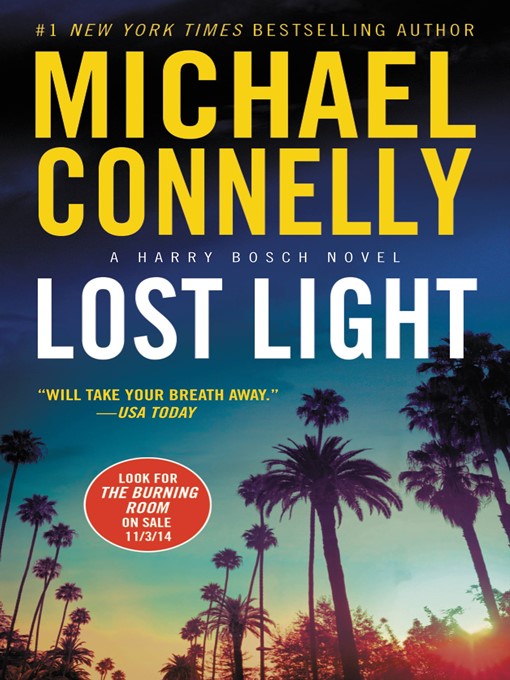
I have just finished the ninth Harry Bosch novel from mystery writer Michael Connelly. Called Lost Light, the title ultimately refers to a Bosch-ism from an earlier novel. In it (I've forgotten which title at the moment), Harry explains that in Vietnam, they called phantom lights seen deep in the tunnels "lost light" because their source was unknown. Perhaps they were traces of light leaking in from above, maybe they were the souls of men who had lived and died in those tunnels. Regardless of its origin, lost light is a reprieve from the darkness that exists in the black maze of tunnels, however spooky it may also be to the seer.

In the novel Lost Light, Connelly does not return to the subject of Vietnam, but instead to the ghosts that haunt Harry Bosch. As the epitome of a tortured soul, Harry has plenty of so-called ghosts hovering around him. In this book he begins researching a cold case from the stack of unsolved murder books he took with him when he left the Hollywood division of the LAPD. Jobless and drawing only his pension (which Connelly tells readers is "more than he needs"), Harry seems much more tormented by the free time he has now than by his lack of active salary. So he begins to fill that time by reworking the cases which still weigh heavily on his mind.

Bosch soon discovers that the so-called cold case he is re-investigating sans police badge is actually a current case for one government body -- the FBI. More particularly the anti-terrorism unit. As you might imagine, this causes immediate issues for Harry and those helping him on the case -- most notably return character Special Agent Roy Lindell, retired LAPD cop Lawson who was injured in the line of duty, and Harry's ex-wife and former Special Agent Eleanor Wish.

Wisdom does come with old age, and Bosch proves this as he handles himself and the case with finesse. However, his personal life is never something he can get a handle on. His rocky on-again-off-again relationship with Eleanor comes into play in this novel, with a surprise twist at the end. Connelly both opens and closes the novel with a line from an Ezra Pound poem that Harry remembers from his marriage to Eleanor: "There is no end of things in the heart." Connelly proves this in more ways than one in Lost Light and shows readers once again that Harry Bosch is hard-boiled but not hard-hearted.

As a pre-quel to this novel and a sequel to the eighth novel City of Bones, enjoy a fictional interview between Michael Connelly and Harry Bosch by clicking here.

Monday, July 27, 2009

Walking the Crime Beat


I'm still in the midst of Harry Bosch, Rachel Walling, and Michael Connelly's motley crew of characters. While reading his Harry Bosch series, I have enjoyed learning about the culture of Los Angeles. No, not just Hollywood and the stars on the sidewalks (although that, too), but the real Los Angeles. Bob's Doughnuts from the Farmer's Market. The view from Mulholland Drive. The woods behind the Hollywood Bowl.

However, in both The Poet (1996) and A Darkness More Than Night (2001), I got a little bit of that world mixed in with new worlds created by Connelly. The Poet is a Harry Bosch-less novel featuring new characters Jack McEvoy and Rachel Walling. McEvoy is a newspaper reporter who writes only about murders. He is, one could say, the perfect foil to Bosch's hardboiled detective. McEvoy is the person who lurks in the corners at the courthouse, waiting for policemen like Bosch to step out and into their journalistic spiderweb. McEvoy has his sources, though. Most of all, his brother who is a policeman himself. McEvoy lives in the Denver area, a departure for Connelly and his thus far constant California setting.

In The Poet, McEvoy has lost his brother Sean to an alleged suicide. McEvoy knows there is a darkness to policework that causes investigators to sometimes lose sight of what is important and become hopeless. However, he doesn't believe his brother succumbed to this void. McEvoy goes on a mission to find his brother's killer -- if, in fact, it was someone other than his brother himself. Along the way he involves the FBI and the enchanting Rachel Walling enters Connelly's literature universe. Walling is tough, and she usually gets her guy. Together, McEvoy and Walling form a team that seeks only the truth. The Poet is a haunting novel. Even Stephen King thinks so -- in a reprint King writes an introduction which warns the reader that he wanted for more lights during the nights he stayed up reading the novel. King lauds it as a perfect mystery that both thrills and chills. Connelly doesn't disappoint in his most compelling work to date.

Connelly returns his readers to Bosch's world in A Darkness More Than Night, but rather than making Harry the main character, he gives Terry McCaleb (of Blood Work (1998) fame) that honor. The retired McCaleb is brought in as a consultant on a case which quickly leads him to his old colleague Harry Bosch. As Jack McEvoy joins them and squeezes all parties for his next lead, Bosch runs into danger and McCaleb is the only one who can clear him. The problem? McCaleb isn't sure Bosch is clean. He knows what can happen to a detective after too many years on the job, and Bosch's twenty plus years just might be long enough to lose a little bit of himself. It is a fast-paced novel which ties together three of Connelly's best-crafted characters.

Connelly returns to a strictly Harry Bosch storyline in City of Bones (2002). The novel is dark, full of serious issues and emotions that run deep. The reader learns about child abuse in all its dark secrets, the terrors of the Vietnam War tunnels, and the hard lessons learned from walking too close to the line between danger and safety. Bosch, never a happy man, is tortured throughout the novel in dangerous ways. Connelly provides no relief for Harry in this brutal novel that examines new pieces of Bosch's past and threatens his future.

I'm currently going backwards in time and reading Connelly's thus-far stand-alone novel Void Moon (2000), which features the new character Cassie Black. I'm only on page 17, so I can't make a judgement. However, I will say that so far Connelly has taken me into a casino where some type of crime takes place, and then into the head of Cassie -- and it's (no surprise!) a dark one. So far Ms. Black is pretending to be someone she is not as she views a home for sale during an open house. The twist? She seems to know a bit too much about the family who lives there and to be a bit too interested in the young daughter. At the moment the realtor is catching her in the act as she peruses the artwork hung on the girl's easel. I can't wait for pages 18 through 448!

Below, I share with you a brief statement from Michael Connelly regarding one of my next Harry Bosch reads, The Narrows (2004):


Michael Connelly/ The Narrows
Available at http://video.google.com/videoplay?docid=-7186687186421359952

Saturday, July 18, 2009

Book Blogging & Harry Bosch

I've decided to give up the charade and tell the truth... My blog is about books! From now on, I'm going to devote myself solely to writing about the main "hobby" in my life -- reading. Occasionally I might venture into the world of cinema or music or travel or food, but for the most part I'll stick to what I do best. Talking about the things I'm reading: the characters, the settings, the series, the writing.

To begin my venture, I'll pen a few lines about my latest obsession: Michael Connelly.

I have long read mystery series. I have been a voracious reader my entire life (and a voracious book collector... even at 9 and 10 years old, I had shelves upon shelves of Sweet Valley High books, Anne of Green Gables and all subsequent novels, Judy Blume books, Beverly Cleary... ah, the list goes on and on). I sometimes claim that my love of mysteries began with Patricia Cornwell. On a family vacation my mom handed me Postmortem. I resisted (weren't mystery books only a fraction of a hair above romance novels, in their formulaic sameness?), but ultimately read the novel in less than 24 hours. Then I read every Scarpetta novel written to date.

After I was done with Kay and Pete and Benton (you know, a week or so later), I searched for other female protagonists. I came upon Sara Paretsky's V.I. Warshawski, whose series I also gulped down in very few days of late nights and little sleep. Then came Skip Langdon, from New Orleans writer Julie Smith. I was on a virtual female-protagonist-mystery-series journey. Along the way I met Marcia Muller's Sharon McCone, Perri O'Shaughnessy (actually two sisters' pen name)'s Nina Reilly, Sue Grafton's Kinsey Millhone, Laura Lippman's Tess Monaghan, and Linda Barnes's Carlotta Carlyle, among others. I couldn't get enough of those tough, driven (okay, sometimes tortured) women who were out there solving crimes and fighting criminals. For a list of female crime-fighters created in mystery novels, click here.

Recently, I began to think I might want to branch out of my "reading rut" and look into the possibility that MALE protagonists might sometimes be just as good. (Probably not, I thought, but I should at least attempt to break free of my sexist ways.) Imagine my surprise when I found Michael Connelly and his main character, police detective Harry Bosch. Bosch is dark, and tortured, and his sordid background pushed him into a life not of crime, but of solving crimes. I couldn't find the first two novels, so I started with Connelly's third novel, The Concrete Blonde (made famous by former President Bill Clinton when he walked out of MysteryBooks in Washington, D.C. carrying an advance copy of the novel). Let me just say here that I never do this -- I always start with #1 and go from there. This was just a try, to see if I liked Connelly's writing. And I did. I read the next few in quick succession, then began A Darkness More Than Night. And stopped.

It was listed as a Harry Bosch-series novel, but it began with Terry McCaleb. As I flipped through, I saw McCaleb's name throughout the novel. I needed to do some research. I found that McCaleb was also a repeat character for Connelly, first seen in a novel called Blood Work. This novel was a bit more famous than Connelly's other works for one simple reason -- esteemed actor and director Clint Eastwood made a film based on it. I watched the film, then decided to read up a bit more on the series I was blindly reading my way through. I found that not only has Connelly written Harry Bosch's series, but he's also written several others and several crossover novels with both Harry Bosch and other recurring characters. I'm now in the process of reading all of Connelly's novels, in order, regardless of character. That way when I come to crossover novels, I'll know the background on all of them.

Here are the Michael Connelly novels in chronological order, with characters:
The Black Echo (1992): Harry Bosch
The Black Ice
(1993): Harry Bosch
The Concrete Blonde
(1994): Harry Bosch
The Last Coyote (1995): Harry Bosch
The Poet (1996): Jack McEvoy & Rachel Walling
Trunk Music (1997): Harry Bosch
Blood Work (1998): Terry McCaleb
Angels Flight (1999): Harry Bosch
Void Moon (2000): Cassie Black
A Darkness More Than Night
(2001): Harry Bosch, with Terry McCaleb & Jack McEvoy
City Of Bones
(2002): Harry Bosch
Chasing the Dime (2002): Henry Pierce
Lost Light
(2003): Harry Bosch
The Narrows
(2004): Harry Bosch, with Rachel Walling & Terry McCaleb
The Closers
(2005): Harry Bosch
The Lincoln Lawyer (2005): Mickey Haller
Echo Park
(2006): Harry Bosch, with Rachel Walling
The Overlook
(2007): Harry Bosch, with Rachel Walling
The Brass Verdict
(2008): Harry Bosch, with Mickey Haller & Jack McEvoy
The Scarecrow (2009): Jack McEvoy & Rachel Walling
9 Dragons
(2009): Harry Bosch

LinkWithin

Related Posts with Thumbnails