Friday, October 30, 2009

Pat Conroy's Love Affair With Food

In the spirit of two of my favorite things -- books from the south & cookbooks -- I recently read Pat Conroy's foray into foodie writing and recipe-sharing, The Pat Conroy Cookbook: Recipes of My Life.

You'll notice that I said "read," not "browsed." That's because Conroy's cookbook reads like a memoir, with recipes peppered in here and there. Don't get me wrong, Conroy includes plenty of recipes. Recipes for everything from pasta dough and fish stock to creme brulee and stuffed pork chops. But rather than simply listing recipe after recipe, Conroy gives us something more. He gives us the story behind the recipe.

Conroy tells us his history with food and cooking, from his family's move to a place he could finally call home (Beaufort, South Carolina) to his time spent as an ex-pat in Italy. Conroy tells us why he loves to cook and how he learned to cook (his first wife went back to pharmacy school and he was put in charge of nightly dinners for the family). Most of all, he tells us what he loves to cook. And with his recipes in front of us, we get to try our hand at replication.

Karen White Paints Pawleys Island with Both Darkness & Light


How I have missed Karen White all these years I have no idea. I've read almost every female author to come out of the south in the past decade (and a few males thrown in for good measure). I've read every book Dorothea Benton Frank has written, all Mary Kay Andrews's novels and her pseudonym mystery series, Kaye Gibbons's complete works, everything Cassandra King has written. Most of Lee Smith. All of Anne Rivers Siddons. I own most of Ellen Gilchrist, save a book or two. Michael Lee West... Well, you get the idea.

So again, I'm not really sure how Karen White escaped my attention or fell under the proverbial radar. But she did. Well, no more. I would like to kick myself now, because the only reason I picked up one of her novels (at a great used bookstore in Crossville, Tennessee, called the Book Cellar) is that she was speaking at the Southern Festival of Books. I missed her session and never read the novel, The Color of Light, until this week.

To be perfectly honest, I think the book jacket threw me off a bit. I'll give you a sampling of it so maybe you'll understand why I wasn't just chomping at the bit to open it up:

At thirty-two, Jillian Parrish finally finds the courage to take charge of her life and discover what really lives in the dark spaces under her bed. Pregnant and recently divorced, she takes her seven-year-old daughter to seek refuge and solace on Pawleys Island, South Carolina -- Jillian's only source of happy childhood memories. Summers spent at her grandmother's beach house were Jillian's sanctuary from indifferent parents until her best friend, Lauren Mills, disappeared. . . . As ghosts of the past return to haunt them, and Jillian's daughter begins having eerie conversations with an imaginary friend named Lauren. . . .
A bit dramatic, isn't it? I'm not into overly-dramatic. I'm into good reading. And I wasn't sure I would get it out of a book about "uncover[ing] the truth. . . about the feelings. . . kept buried for sixteen years." Let's just say that I was pleasantly surprised.

The genre for The Color of Light is kind of hard to define. White combines elements of a southern gothic novel, chick lit, and mystery into one. There is a strong plot replete with twists and difficult challenges which the characters must face. And the characters themselves are unexpectedly likeable. The setting, of course, couldn't be better. Pawleys Island, with the beach and the southern tidbits, is nothing but interesting. There is also a strong supernatural element in the novel, as White creates a world where ghosts speak and intuition runs strong. The ending becomes a bit cliche, both in the love story portion of the plot and in the surprises that unfold. Overall, however, it is a deeply satisfying novel about a woman who finds exactly what she seeks -- answers to past mysteries and a new beginning.

You can catch White on her current book tour in and around the south (primarily Georgia) as she promotes her new book, The Girl on Legare Street, which is a sequel to the bestselling The House on Tradd Street.

Tuesday, October 27, 2009

Just Another Jennsylvania Memoir

I have this little OCD issue -- when I do something, I do it all the way. I mean ALL the way. Therefore, if I start reading an author & I find that I like that author immensely, I will read all of his or her books (see multiple previous posts about Michael Connelly). Even if it kills me to find those books in used book stores, Targets, and Barnes & Nobles across the land -- or Amazon.com.

Why am I rambling on about OCD & reading all of the books written by an author & searching for difficult-to-find titles? Well, I finished Jen Lancaster's second book this week (after stumbling upon it in Target's excellent book department). It has a doozie of a title -- Bright Lights, Big Ass: A Self-Indulgent, Surly, Ex-Sorority Girl's Guide to Why it Often Sucks in the City, or Who are These Idiots and Why Do They All Live Next Door to Me? You really can't find better titles & subtitles than on Lancaster's memoirs. Actually, I'm not sure longer titles exist anywhere in the history of book titles.

In reading my way backwards through Lancaster's works I have learned something: she became a better writer over time. Her last two books were hilarious and genius and entertaining. This second book was funny and insightful and relate-able. But I'm not sure it was quite as good as those that follow. It chronicles Lancaster's life as she finishes her first novel and readies it for publishing. While that is a theme throughout the book, the memoir lacks direction and often reads as a series of essays rather than one continuous story. Complaints though they may be, I still enjoyed the book enough to complete it and even recommend it.

Lancaster still has some of the funniest email inclusions, one-liners, and comedic situations that I've ever read. One particular favorite was the story of her (only) friendly neighbor who has a friend come stay with her to detox. Said neighbor has to leave on an extended business trip, leaving the A&D-treatment-needing houseguest to terrorize the neighborhood with her loan inquiries and drunken (and once naked) escapades. Lancaster is also the master of making you laugh out loud with ordinary moments. Here's an outtake from the book:

"Hold on, let me check with my wife -- Jen, how about a noon appointment with the apartment brokers on Sunday?"
We haven't found anything yet, the rain's coming down harder in the kitchen, Tracy [neighbor's addict houseguest] has yet to be carted off to proper rehab, and I'm starting to feel desperate. "Sounds good."
Five minutes pass as we both quietly work on our laptops. The icon blinks telling me I have mail, so I log on. "Hey, Fletch, I got an email from you."
"Uh-huh, I know."
I open the email and scan it's contents. "Whoa, is this a meeting request to look at apartments on Sunday?"
"Yes."
"Are you trying to be funny?"
"No. I used the Yahoo Scheduler. Now you can add this to your Yahoo Calendar so you can manage your personal affairs."
"But I don't have a Yahoo Calendar an I was sitting ten feet away from you when you made the call. And as eager as I am to move out of Melrose freakin' Place, chances are good I won't forget this appointment."
"Au contraire. You do have a Yahoo Calendar. I set it up for you."
I'm getting agitated. "You're missing the point -- I don't need a Yahoo Calendar to manage my personal affairs, nor do I want to receive meeting requests from you."
He is resolute. "It's very handy."
"That may be, but when you email your wife to schedule an appointment, you set an ugly precedent. What's next, sending me a request to clean the bathroom on the third floor?"
"Now that you mention it..."
"Sweetie, I love you, but I promise that I will smother you in your sleep if you ever assign me a chore via email."
Five more minutes go by while we both quietly work on our computers, and then Fletch asks me, "So, are you going to respond to that request?"
"Fletch? This? Right here? Is exactly why you used to get beat up in junior high school." (p. 272-273)
Lancaster has a blog which you can follow if you're interested in her life & public appearances. She also has a new book coming out sometime soon (I hope!). And yes, although I have found that quality somewhat diminishes as you go back in time with an author, I will be searching for a copy of Lancaster's first book so that my reading will be complete (and so that my OCD will be appeased).

Sunday, October 18, 2009

Comfort Food and Easy Reading

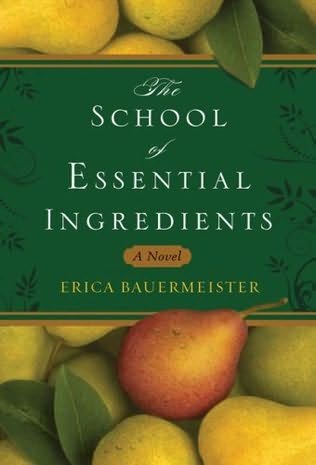
Lillian has taught many cooking classes, but none like this latest one. In her novel The School of Essential Ingredients, Erica Bauermeister tells the tale of each student in Lillian's newest class of students. It is an easy, short read, but one replete with emotion. Bauermeister links the emotion of the classmates to the dishes that they cook. Lillian tells her own story first, followed by chapters based upon each character.

It is an uncomplicated series of stories that focuses more on human experience than on the plot. However, Bauermeister does connect the stories loosely by always coming back to the cooking class. My main disappointment was the lack of recipes -- not a single one. I think that Bauermeister was backing her lead character, Lillian's, statement early on that she would never hand out a recipe for her students to follow. However, it was difficult to read a book with so many beautiful descriptions of food and no true instructions on how to prepare them yourself. I found myself searching Food Network's website for similar recipes!

Lillian (through Bauermeister) explains why the class had been particularly special in this passage towards the end of the novel:

It had been a good class, Lillian thought, and spring was already in the trees. A new class would start soon. Lillian always felt a bit of sadness at this point, expected it even. This time, however, Lillian felt more regret than usual. She had always loved being the teacher, the one who knew the spices that would make up a memory, heal a heart. She enjoyed holding the knowledge in her mind like a secret, figuring out which student needed which gift. But this class was different. These students gave to each other, reaching out among themselves with such grace. She saw how connected their lives had become and would remain. Where did a teacher fit in the picture, she wondered, when there was no longer a class? (p. 240)

Friday, October 16, 2009

Silas House is a God (With a Southern Drawl)

Because things are a little crazy right now, I could only attend one day of the Southern Festival of Books this year. Actually, I only attended one session -- Silas House & Martin Wilson speaking on quite a topic: "Coming of Age in the South — Exploring the Complexities of Adolescence in Fiction." I suppose they did speak to this subject, but primarily they talked about and read from their latest works. For Martin Wilson, his tale of two brothers titled What They Always Tell Us. Wilson read from a section from the point of view of the younger brother, who has attempted suicide recently. I enjoyed listening to him, but the main attraction for me was Silas House.

I have read every book he's written (only three to date), and then reread them. There are very few books that I reread. I just don't like to do it. I like style and ingenuity and all that, but I read for the plot and the characters. Once I know what happens in a book, I have no desire to read it again (usually). House's books are the exception for me. I had already read both Clay's Quilt and A Parchment of Leaves twice, then I reread Clay's Quilt again for a book group in a class I took a few semesters ago. It came alive for me again, and I ended up writing my final paper on the music that House uses throughout his writing.

While all three of his previous works were centered on the same family of characters, House's new book Eli the Good is a stand-alone novel set in the summer of 1976 during the country's bicentennial. Eli is ten years old, and House told us that he never actually intended to write a young adult novel (nor does he necessarily think this is one), but it just sort of happened that his editor felt it was YA. House said that he feels the novel is just a novel, not specific in its genre. While Eli is the main character, House also tells the story of Eli's mother, father, and aunt. Set just after the Vietnam War, that conflict in our country's history plays a large part in the novel, as well. My only disappointment of the day was looking for Eli the Good only to learn that every booth at the Festival was sold out. So I couldn't stand in line to sing House's praises and get his autograph on my reading material. (It's on its way from Amazon, though!)

I did, however, ask House a question during the session: "Could you speak for just a moment on the influence that music has on your writing?" House makes some of his money as a music writer in Nashville. His latest project was spending several days with rock legend Kris Kristofferson and putting together a press kit for him. House told me (and the rest of the audience -- but let's be honest -- when one of your favorite authors is answering YOUR question, he's really just talking to you!) that he knows two things about the characters when he begins a novel: what their names are and what kind of music they listen to. House said that he wouldn't know how to write without music. To him, life and music are so intertwined it would be impossible to separate the two. It's a beautiful way to write.

Sunday, October 11, 2009

More Tortured Love Nonfiction, Stalker-Style


Last week I read yet another nonfiction book about a battered woman. As a life-long volunteer with domestic violence groups & shelters, I suppose it makes sense for me to always be interested in real, female-centered stories. In Kate Brennan's In His Sights: A True Story of Love and Obsession, the author tells her story of mental and emotional abuse at the hands of a lover. Kate Brennan is not the author's actual name, but rather a pseudonym chosen to protect her identity from the stalker who still watches her.

Brennan begins her story with a tale of courtship. She meets her neighbors' nephew at their anniversary party. Paul, also a chosen pseudonym, pursues her with a determination unmatched by her previous love interests. At 40 years old, Brennan had made a solitary life for herself, happy in her solitude and in her successful literary career. Paul disrupts that life, and Brennan invites him further and further into her formerly lonely world. Despite repeated warning signs, evident at least in retrospect, Brennan eventually moves with Paul into his house and gives up her apartment. Paul is wealthy, which he inherited from his father's family, but Brennan tries to maintain her own identity by paying her own way much of the time.

When Paul's emotional and mental abuse begin to take their toll, Brennan eventually realizes that she can no longer continue the sham of their relationship. She tells him she is moving out after a particularly bad weekend in which Paul indulges his sexual addiction and cheats on her with multiple women. She moves into the guest house, and finally out completely.

In this first small apartment, Brennan begins to be tortured in small physical ways -- electricity cut off when everyone on the street still has theirs; phone not working properly; door unlocked repeatedly when she returns home; books moved from room to room. Nothing concrete she can take to the police as criminal act (or at least nothing she has proof of). Then things begin to escalate -- she notices people watching her, a man attacks her when she is traveling to London, her house is under seige by someone trying to break in. Then Paul and his new wife move in across the street, and Brennan becomes seriously afraid of him.

Eventually he controls her life entirely, from the outside -- he has her hired to a job position at a university, then presses those in her life (a fellow committee member, her landlady) for details. He calls her family members for information on a regular basis. She finally has to go to the police, and she lucks into a sex crimes department that would rival Law & Order: SVU's. They are informed & helpful. They offer her tips and investigate Paul thoroughly. All the same, they are unable to fully protect her. Brennan lives a life on the run for several years, then finally decides she can take it no more. She settles, but continues to be terrorized by Paul in both little and big ways. At the time of publishing, Brennan's stalker is still out there, on the loose and harassing Brennan from time to time.

Brennan's portrayal of a woman being stalked by a person she formerly thought she loved is both terrifying and eye-opening. It is a must-read for females, if only in its lesson-teaching. Relationships will never be so examined as they are after reading this novel. It will leave every woman wondering if her partner could turn into such a monster.

Read the New York Times review of this book for more information and an interview with the author, or read the Marie Claire article interview with Brennan. View the Good Morning America/ ABC News story below:

Author Stalked for 10 Years

Sunday, October 4, 2009

Exploring the Outlaw Side of Life in America


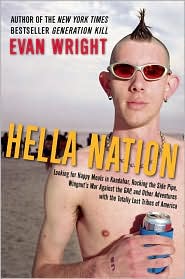
I'm fairly prone to nightmares. Sometimes the things I see or read contribute to those; sometimes they don't. After reading several essays from Evan Wright's Hella Nation: Looking for Happy Meals in Kandahar, Rocking the Side Pipe, Wingnut's WarAgainst the GAP, and Other Adventures with the Totally Lost Tribes of America, my nightmares were definitely the result of what I had learned about.

It's not that I'm completely naive when it comes to the ways of the world. I've written research papers on female serial killers. I used to subscribe to Marie Claire, a magazine whose world coverage of the female condition is unmatched by other women's magazines. I've read mystery and thriller novels that detail the most heinous crimes imaginable. But for some reason, the people who are the subject of Wright's writing got to me.

Wright is a "Gonzo journalist," who immerses himself in the stories he is writing. Although in the introduction to Hella Nation he argues against this label, stating that he doesn't focus on himself, I have to agree with those who consider him such. According to the Wikipedia article about Gonzo journalism, it is:

a style of journalism which is written subjectively, often including the reporter as part of the story via a first person narrative. . . . The word Gonzo was first used in 1970 to describe an article by Hunter S. Thompson, who later popularized the style . . . . Gonzo journalism tends to favor style over accuracy and often uses personal experiences and emotions to provide context for the topic or event being covered. It disregards the 'polished' edited product favored by newspaper media and strives for the gritty factor.
Using this as a definition, Wright meets on all fronts. He involves himself in the subject matter, using first-person point of view to describe the scenes and people. He also uses his own experiences to write supposed non-fiction pieces that some would argue are orchestrated by him. And they're definitely gritty.

In this collection of essays, all of which have appeared previously in publications from Rolling Stone to Vanity Fair to LA Weekly, Wright pens stories about everything from the dotcom boom to 1930s style dance halls still in existence to a fatal dog attack to a group of Aryan Nation followers led by a self-proclaimed Christian preacher. The collection is meant to tell the story of those living below the radar, far from the norm of everyday society. Wright definitely accomplishes this, but what else he accomplishes is unknown. For me, obviously, it was frightening.

Looking into the darkness of society is not necessarily something I want to do regularly. I found the portraits of real people scary in terms of what it meant for America. It's not that I don't promote free-thinking or acting on your beliefs. But when that means vandalism (in the case of anarchists breaking windows out of GAP stores) or killing people (like Timothy McVey, a follower of the Aryan Nation group ), I have to be against it. Not only against it, but scared by it. Thus, the nightmares. Nevertheless, I'm glad I happened upon Wright's book. People like those in his book definitely exist, and they are out there. It's interesting, if nothing else, to read about their lives, which are so completey separate from my own.

Wright is also the author of Generation Kill, a book based on his experiences as a reporter embedded with American troops during the beginning of the Iraqi War. It was later made into an HBO miniseries.

LinkWithin

Related Posts with Thumbnails