Sunday, August 30, 2009

What's the Difference Between a Defense Lawyer & a Catfish?

The way the joke goes, one is a bottom-feeding scum sucker and one is a fish. In Michael Connelly's first Mickey Haller novel The Lincoln Lawyer, this joke follows the main character from courtroom to his own home. First told to him as an insult by a police officer, Haller later tells the joke himself. The joke serves as a metaphor for Haller's life and highlights his epiphany, which slowly occurs throughout the course of the novel.

Haller is similar to Harry Bosch, Connelly's long-time series detective, in that he's rough around the edges, but different because he at first seems beyond liking. Haller is a defense attorney, like his father before him. He bluntly talks about both his failed marriages as faults of his own. However, as I read the book, Haller started to grow on me. At one point his first ex-wife and the mother of his child tells him that she doesn't understand his innate likeability. Although he defends despicable clients who commit crimes against people and themselves, he remains close to both his ex-wives; one is his go-to "pick me up from the bar when I've had too much to drink" friend and one works for him. He has losers for friends -- shady private investigators and low-down bail bondsmen. However, in some way as I read I began to like them, too. Connelly has that ability -- to make the seemingly unlikeable character become very likeable. So likeable, in fact, that you end up rooting for them in the end.

And that is what Connelly accomplished in this book. I began it thinking that I wouldn't like it very much because it was a stand-alone (at the time it was written -- since then, Haller has joined Bosch in books). I was reading it simply to get on to the next Bosch novel. But as I read, I began to like the characters and to be genuinely interested in the novel's outcome. The evil client thrown in for good measure doesn't hurt, either. I love a good serial killer story! Connelly comes back to themes he writes about often -- broken relationships, corruption within the LAPD, the ins and outs of the court system -- in this book, and thank goodness. That's one of the reasons I'm reading all of his novels.

This novel is every bit as good, in a nail-biting sort of way, as the Bosch novels are. Now I have to look forward to the crossover novels...! (Can't wait, can't wait!) A small excerpt to get you started:

"I know my place in this world and on the first day of court next year I will pull the Lincoln out of the garage, get back on the road and go looking for the underdog. I don't know where I will go or what cases will be mine. I just know I will be healed and ready to go stand once again in the world without truth." -- Mickey Haller, The Lincoln Lawyer

Tuesday, August 25, 2009

Julie Powell Would Never Say Julia Child Was Adorable


I picked up a bargain-priced paperback version of Julie Powell's Julie & Julia during a midnight Wal-Mart run a few weeks ago. I wasn't sure if I would like it. After all, I'm not much of a blog reader, other than for a few friends and family.

Well, I should say I WASN'T much of a blog reader. That is, until I found a couple of good blogs via www.blogger.com's "Next Blog" feature. I began "following" them, for something interesting to read. Then I bought Julie & Julia. I didn't begin reading it until just a few days ago. In between the buying date & the beginning-the-book date, I browsed the web for Julie Powell's actual blog. I found her (now-defunct) original Julie/Julia Project blog. I wasn't really that impressed. Now, because I had neither read the book or watched the movie, I must admit I didn't have a vested interest in reading the blog. I was just browsing/ scanning.

Then I read a story on CNN.com about bloggers who were formerly anonymous and who were fired after they "came out," among them Heather B. Armstrong. So, of course, I googled Heather and found her blog Dooce. And started following it. And read about three months' worth of back blogs. Then I continued my blog-craziness by reading Jennifer Lancaster's blog Jennsylvania because I read her (very fabulous and funny) memoir Pretty in Plaid recently. So in short, I became very interested in not only writing a blog, but also in reading them. They're pretty good. You should try them out (especially the ones mentioned above!).

Anyway, after/during all of this blog madness (which I must admit, partially came because for a week or two I could just not find a book I wanted to read -- which KILLED me), I finally pulled the Julie & Julia paperback off the shelf and started reading. And loved it.

Julie Powell is intensely funny, extremely profane, and -- most importantly -- a "real" character. I suppose this might be because she is a real person... But in saying she's "real," I mean more than that she is simply alive. She's flawed, and she loves her husband but is annoyed by him, and she loves her mother but is annoyed by her, and she has wonderful (crazy) friends who she loves but doesn't always treat properly. She's stuck in a dead-end secretarial job and she feels sometimes that even though she has a good husband and an income and an apartment in New York, she might never want to get out of bed (or stop drinking gimlets). THAT is why I like Julie Powell. And it's also why I have been devouring her book, much as she devoured every meal Julia Child lays out in Mastering the Art of French Cooking during her year of cooking and blogging.

As soon as I'm done, I'll read the backlog of blogs on Julie's current blog What Could Happen?

Monday, August 3, 2009

I Clean House While Mom Shops for Books


Sadly, a busy day has left little time for reading. However, my mom found time this afternoon to shop at my favorite book store -- McKay Used Books. She tried to find some of the titles I'm wanting to devour prior to October's Southern Festival of Books, but had no luck. I'm sure I'll make a trip of my own within the next few weeks so that I can load up on all I can find to prepare for the literary festivities to begin.

McKay is a book store which originated in Knoxville, Tennessee, but now has locations in Chattanooga and Nashville, as well. I first found McKay while working on my English degree at UT Chattanooga. I honestly can't remember how it happened, but if I had to guess, I'd say a professor or fellow student mentioned it and I had to go asap! McKay stocks every kind of book you can imagine, from newly released fiction to self-help to textbooks. They also carry a wide array of DVDs, CDs, and audio books. In addition, when they can they also sell electronic items such as iPods & gaming systems.

Their best deals by far are on books. While some brand new titles might set you back as much as $14, most books are in the $2-$5 range. They also always have a section called "Bargain Books". You might think this would be books that are boring, terribly written, or otherwise un-readable. You would be wrong! Often, this section is full of books McKay has received too many copies of because it was a popular, best-selling title. I can't tell you how many Oprah's Book Club selections I've found a couple of years after their being honored by that distinction on the bargain shelves.

McKay receives so many because their primary way of getting in new stock is from their customers seeking trade value for books they've read. This might seem like blasphemy to people who are book collectors, much like myself, but I've been known to "sell back" books which weren't that good or which I simply didn't need to keep after having read. Thank goodness there is an entire population of people who don't feel any kind of sentimental emotion towards books and can get rid of them for cash or trade value. Otherwise, McKay would only stock books that weren't that good. Instead, they have a wide array of great titles "sold back" to them by people who bought them new (or used) and traded them in for the next round.

Visit McKay Used Books in Knoxville just off Papermill, in Chattanooga on Lee Highway, or in Nashville on Charlotte Pike. For directions to any location, visit the McKay website here.

Saturday, August 1, 2009

Harry Bosch Expounds Upon Ezra Pound's Poetry


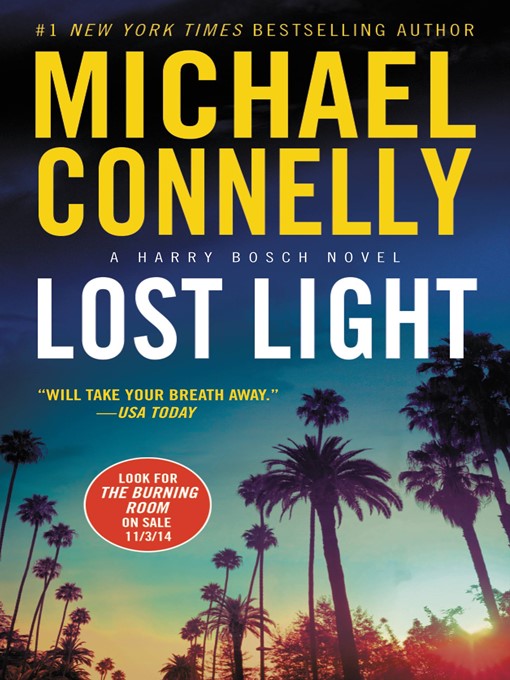
I have just finished the ninth Harry Bosch novel from mystery writer Michael Connelly. Called Lost Light, the title ultimately refers to a Bosch-ism from an earlier novel. In it (I've forgotten which title at the moment), Harry explains that in Vietnam, they called phantom lights seen deep in the tunnels "lost light" because their source was unknown. Perhaps they were traces of light leaking in from above, maybe they were the souls of men who had lived and died in those tunnels. Regardless of its origin, lost light is a reprieve from the darkness that exists in the black maze of tunnels, however spooky it may also be to the seer.

In the novel Lost Light, Connelly does not return to the subject of Vietnam, but instead to the ghosts that haunt Harry Bosch. As the epitome of a tortured soul, Harry has plenty of so-called ghosts hovering around him. In this book he begins researching a cold case from the stack of unsolved murder books he took with him when he left the Hollywood division of the LAPD. Jobless and drawing only his pension (which Connelly tells readers is "more than he needs"), Harry seems much more tormented by the free time he has now than by his lack of active salary. So he begins to fill that time by reworking the cases which still weigh heavily on his mind.

Bosch soon discovers that the so-called cold case he is re-investigating sans police badge is actually a current case for one government body -- the FBI. More particularly the anti-terrorism unit. As you might imagine, this causes immediate issues for Harry and those helping him on the case -- most notably return character Special Agent Roy Lindell, retired LAPD cop Lawson who was injured in the line of duty, and Harry's ex-wife and former Special Agent Eleanor Wish.

Wisdom does come with old age, and Bosch proves this as he handles himself and the case with finesse. However, his personal life is never something he can get a handle on. His rocky on-again-off-again relationship with Eleanor comes into play in this novel, with a surprise twist at the end. Connelly both opens and closes the novel with a line from an Ezra Pound poem that Harry remembers from his marriage to Eleanor: "There is no end of things in the heart." Connelly proves this in more ways than one in Lost Light and shows readers once again that Harry Bosch is hard-boiled but not hard-hearted.

As a pre-quel to this novel and a sequel to the eighth novel City of Bones, enjoy a fictional interview between Michael Connelly and Harry Bosch by clicking here.

LinkWithin

Related Posts with Thumbnails