Showing posts with label New England fiction. Show all posts

Thursday, June 30, 2011

Live to Tell Provides Creepy, Satisfying Audio Book Experience

When I search for audio books to listen to, I am really attempting to find books that will give me as good an experience as I've had with Lisa Gardner's D.D. Warren series.

For multiple reasons, Gardner's books work extremely well in audio format. First, they are full of suspense, which lend themselves well to being read aloud and keeping my attention. Second, her publisher does an excellent job of choosing voice actors -- yes, plural. As in, multiple voices reading various sections. Third (but somewhat tied to second), Gardner's novels are written from several different points of view: the police, the victim, the suspect, among others. These varying narrators (all read by different actors) draw the reader in by revealing a full, rounded narrative.

Live to Tell, the fourth book in the D.D. Warren series, is no exception to that rule. It was an exceptional read (or listen, if you will). Gardner's books seem to only get better as she matures as a writer. As she has also written another series as well as several standalone novels (this is her twelfth book overall), Gardner has plenty of experience under her belt at this point. Kirsten Potter once again narrates as voice actor, along with a whole cast of supporting narrators.

Several reviewers both on Amazon and on Goodreads denounced Live to Tell for its difficult-to-stomach content. Gardner does include things that are unsettling to read or listen to, but that's par for the course when you're reading one of her novels. I would venture a guess that those reviewers had never read her previous works. If they had, they would have expected a certain level of unease that comes with reading her books. Gardner writes mystery/thrillers, and that genre brings with it murder, psychological terror, and even fear.

Live to Tell tells three different stories that merge into one throughout the course of the novel. First, Gardner introduces Danielle Burton, a nurse working in a children's psychiatric ward. Danielle lived through her own family dysfunction at a young age and now helps children with similar family issues. As the anniversary of her family's deaths nears, she becomes significantly less stable. Simultaneously, Gardner tells the story of mother Victoria Oliver. Victoria lives with her own family demons, ones that despite her best efforts may beat her in the end. When two families are annihilated, Boston detective D.D. Warren is on the case. Warren's character ties this novel to the others in the series, and Gardner gives her readers plenty of updates on her star detective.

However, my favorite part of this series is how different each novel has been. Rather than following a formula in which D.D. Warren solves a case, Gardner makes this series so much more than that. Warren does work the case(s) in each novel, but Gardner delves into side stories as much as she focuses on Warren. As a result, each novel acts almost as a standalone with Warren running through them as a cohesive thread.

Live to Tell is yet another excellent audio book from Lisa Gardner. If you like mysteries and want to try the audio format, I highly recommend Gardner's books. In fact, you will then be spoiled and want to find others that match your experience with her novels! In some ways I wish that I had saved this listen for my upcoming trip to Africa (I leave Tuesday!), but I do have one thing to tide me over: Gardner's newest D.D. Warren series novel, Love You More, already purchased on Audible and loaded onto my iPod for my journey. (I'm also really enjoying Deborah Harkness's A Discovery of Witches via Audible on my iPod.)

If you are a Gardner fan and an iPod or iPad user, Gardner has her own App. Check it out or visit her website for more information about Gardner or her books.

Tuesday, June 28, 2011

The Murderer's Daughters Examines the Effects of Family Violence on Children

The Murderer's Daughters was one of my vacation reads. (One of only three books I read that week -- I expected to read much more, but highly underestimated the time constraints of a huge, extended family vacation. We were beaching and swimming and running around with kiddos much of the time, which was fabulous, but didn't lend itself to lots of reading time!)

You know that phenomenon where you learn about something for the first time, then that same idea or concept pops up everywhere you turn? (Most recently, it was for me a geographical location I'd never heard of. I learned about it on the Discovery Channel, then I read about it randomly in a book, then read about it in an article on the internet -- all in an 8 hour span!) My reading life has been a little bit like that lately. The topic of family violence keeps coming up. My mom would probably argue that it might have something to do with my reading choices, but I assure you I didn't choose this topic knowingly.

I had been listening to Lisa Gardner's Live to Tell, which was entirely creeping me out at night (so much so that I had to find another Audible title to listen to before bedtime to ward off nightmares!). It deals with family annihilation by a father's hands, among other difficult themes. I picked up Randy Susan Meyers' novel The Murderer's Daughters after reading about it on the book blog Bibliophile By the Sea. The audio version even made it onto her Best Books Read in 2010 list.

The novel follows sisters Lulu and Merry from childhood to adulthood. When the two are very small, their father commits an unforgivable act -- he murders their mother in front of the girls' eyes. He is immediately incarcerated, and the girls are passed from family member to family member, then put in various foster care placements. Lulu, the older sister, carries within her a deep-rooted hatred for her father and the terrible changes he forced onto his daughters. Merry, on the other hand, always a daddy's girl, continues to visit her father behind bars.

Most of the action happens at the novel's beginning (and in fact is detailed in the book's description). So the novel is less action-packed mystery and more in-depth psychological analysis of what happens to a family ripped apart by violence. Meyers does an excellent job of describing the plight of children who find themselves parent-less: the responsibilities of the extended family, the horrors of group homes, the loss of innocence and necessary growth of independence.

Also interesting was the contrast between the two sisters' reactions and emotional growth. Merry, while she is able to forgive her father to some extent (therefore showing a certain emotional maturity), is in many ways still a child -- even as an adult. She continues to lean on her sister for support, both monetarily and emotionally. She flits from one bad relationship (or one-night-stand) into another, never finding the right person to share her life with.

Lulu, in sharp juxtaposition to her sister, decides to do it all. She becomes a doctor, then meets a strong and stable man to marry and have children with. They buy a house and build an uber-normal life together. On most fronts, she seems to have it all. But Lulu continues to blame her father for his sins, which handicaps her emotionally. She constructs an elaborate lie for her past, telling everyone -- including her own daughters -- that her parents died in a car accident when she was young.

Lulu's daughters (and Merry's nieces) serve a crucial role in the climax of the novel. While both Lulu and Merry have become complacent in their separate ways of dealing with their father, Lulu's girls force the sisters to face their past together, as one. While they may never see eye-to-eye entirely, in a harrowing incident at the novel's end they must at least begin to work towards understanding.

The Murderer's Daughters is Meyers first novel. She has published short stories in various places and teaches writing at the Grub Street, Inc. Writers' Center in Boston.

Tuesday, June 21, 2011

Lionel Shriver's So Much For That Makes It All Worth It In the End

In her novel So Much For That, Lionel Shriver writes:
"You know, these movies..."[Shep] was groping. "Remember how sometimes, in the middle, the movie seems to drag? I get restless, and take a leak, or go for popcorn. But sometimes, the last part, it heats up and then right before the credits one of us starts to cry - well, then you forget about the crummy middle, don't you? You don't care about the fact that it started slow, or had some plot twist along the way that didn't scan. Because it moved you, because it finally pulled it together, you think, when you walk out, that it was a good movie, and you're glad you went." (404)
As Goodreads member Aaron John Curtis said in his review of this novel, "Lionel Shriver could have been talking about this book."

So Much For That aims to take on several heavy topics: the health care system in America, terminal cancer, Americans' affection for lawsuits, children with disabilities, large corporations, the art world, the housing boom, government taxes, elder care. And to some degree (sometimes too much of a degree), Shriver does indeed delve into those subjects. She has a lot to say in this 448 page tome printed in tiny font -- a lot.

But Shriver's soapboxing was not what made me enjoy this book. Does she make a lot of excellent points? Absolutely. Are some of those excellent points seemingly conflicting (as they often are in real life)? Absolutely. But reading "issue" novels never appeals to me. Jodi Picoult, for all her fans, is not someone whose works I choose to read. I feel as though I understand my own point of view on most controversial topics, as I would guess most readers do. Either you feel one way, or you vehemently disagree; a fictional novel most likely won't change your mind.

Shriver does employ her "soapboxing," as I called it, as a successful method of characterization in the novel, however. Main character Shep's best friend Jackson is a ranter. Meaning,  he enjoys nothing better than a good rant. These rants take on a life of their own at some points in the novel (and, truthfully, become wearing), but in doing so Shriver paints a perfect picture of who Jackson is and who he is not.

Jackson is not the only dynamic, (and -- dare I say it) likeable character in So Much For That. I found the book chock full of characters I loved. That's not to say they were "good." Oh, no. Shriver make sure that each and every character has both good points and extraordinary flaws. Even perfect Shep, as readers will come to think of him eventually, attempts to abandon his family in the novel's opening pages. Glynis, his wife, is both a terrible hag (finding joy solely in others' misfortune) and a sympathetic character as she fights a rare cancer. Her interactions with Jackson's daughter alone will win you over.

And Jackson's daughter -- she is perhaps my favorite of all. Sixteen-year-old Flicka was diagnosed with a rare genetic disease called familial dysautonomia (FD) as an infant. As a result, she can't produce tears, swallow normally, balance properly as she walks, among many other symptoms. However, learning to live with FD has made Flicka feisty rather than downtrodden. She curses like a sailor, talks back to her parents as much as any teenager would, and fights for independence on a daily basis. Both hilarious and heartbreaking, Flicka is as good a character as any author has ever written.

So what's the story? In essence, Shep Knacker has saved his entire adult life for the payoff -- the "Afterlife," as he calls it. He and wife Glynis have taken "research trips" (never vacations) all over the world in search of the perfect "Afterlife" location. Shep has finally decided on an island off the coast of Tanzania called Pemba. After the sale of his handyman company to the tune of a million dollars, Shep is ready to depart. However, things fall apart when his wife reveals that she has cancer -- and she needs his insurance for treatments. What ensues is beautiful, heartbreaking, wallet-emptying fight for her life -- and, in the end, for their marriage.

The rest of the quote above is: "See Gnu [pet name for Glynis]?" he promised. "We can still end well." Because, you see, the paragraph works as both a description of Shriver's novel and for life itself. Sometimes we get restless in the middle, tired of the mundane, people who annoy us, relationships and life goals that don't go according to plan. But in the end, "you're glad you went. . . . [because it] can still end well."

Thursday, May 5, 2011

Jean Kwok's Girl in Translation Finds Its Way to My Best Reads of 2011 List

I've found my reading second-wind lately, resulting in several books read in the past week or two. One of these was the amazing Girl in Translation, a novel by Jean Kwok that debuted in hardback last year and was released in trade paperback format this past Tuesday.

Kwok tells a semi-autobiographical tale of immigration from Asia to New York City in her debut novel Girl in Translation. Here's what Kwok says about the real-life connections in the novel:
"Although Girl in Translation is a work of fiction and not a memoir, the world in which it takes place is real. . . . I turned out to be quite good at school. We moved to New York City when I was five and my only gift was taken from me.  I did not understand a word of English. . . . My family started working in a sweatshop in Chinatown . . . every day after school and we all emerged many hours later, soaked in sweat and covered in fabric dust. Our apartment swarmed with insects and rats. In the winter, we kept the oven door open day and night because there was no other heat in the apartment."
Kwok's main character, Kim, is also talented in one area: academic pursuits. Like Kwok, when Kim moves with her mother to America, she is terrible at school -- because she can't understand the language. Her mother knows even less English that Kim, and the only person they know in their new country is Kim's Aunt Paula, who owns a garment factory. 

Initially, Aunt Paula puts them up in her own house. Then, she finds them an apartment of their own and gives Kim's mother a job. But the apartment is much like the apartment Kwok remembers from her own childhood: full of vermin and without heat. Additionally, Kim must work after school with her mother at the illegal by-the-piece job her aunt so kindly gives them, because otherwise her mother would be unable to complete the demands of the job.

In Girl in Translation, Kwok takes readers inside the mind of a child struggling to learn English, to assimilate to a new culture, to rise above her poverty-stricken circumstances, and to find herself somewhere in between. Kim is a winning narrator; my empathy for her soared throughout the novel. She is far from perfect, but she does the best she can. Often she is ashamed of her family, irritated with her mother, and angry with her aunt -- and rightly so. 

Still, Kim manages to find a place for herself amidst all the outside pressures she feels, as did Kwok. More from Kwok on her childhood:
"As I slowly learned English my talent for school re-emerged. When I was about to graduate from elementary school, I won scholarships. . . . [T]here was still no money to spare. If I didn't get into a top school with a full financial aid package, I wouldn't be able to go to college. . . . In my last year in high school, I worked in three laboratories. . . . I was accepted early to Harvard and I'd done enough college work to take Advanced Standing when I entered, thus skipping a year and starting as a sophomore."
Although Kwok gives her characters a few more fictional adventures than the ones she endured, much remains the same: Kim is an intelligent young lady, who after immigrating to a new country feels ignorant. Through hard work and determination, her confidence returns. 

Girl in Translation has joined my list of best books for the year. Kwok is a literary voice I hope to hear from again. Although this first novel seems to be born of her entire life experience thus far, I have no doubt she will tackle other topics and do so just as successfully. 

The novel has been on my list of books I want to read for months, but I am grateful to have had the opportunity to review it this week for Penguin. A huge thanks to Penguin publicist Erin Galloway for sending me a copy of the new trade paperback version and allowing me to help celebrate the trade paperback release.

Wednesday, May 4, 2011

The Bake-off Transforms Television's Food Network Challenge Into Fiction

Beth Kendrick's The Bake-Off is the novel equivalent of the show Food Network Challenge. However, instead of only seeing food contestants in the midst of a food challenge, Kendrick brings us up close and personal inside the lives of two contestants: estranged sisters Amy and Linnie.

When their Grammy Syl cooks up a plot to get the two of them in the same city for the first time in years, both sisters hesitate. After all, anything they do together ends up terribly. Linnie, once a child prodigy who entered college at 16, threw it all away after one semester. Amy, a dental hygienist at her husband's dental practice and mother of twin toddlers, lost herself long ago to diapers and laundry. Linnie has never even met Amy's children; they organize family get-togethers around one another's schedules to avoid being in the same place at the same time.

Szarlotka, via Flickr
But Linnie needs money, and Amy needs excitement. So the two end up as partners in the Delicious Duet baking contest, a dessert challenge in which the winners receive $100,000. Initially, neither sister can bake. In fact, they are somewhat of a disaster in the kitchen. But armed with Grammy's szarlotka recipe (and after several days of baking boot camp thanks to Grammy), they actually begin to stand a chance at winning.

The Bake-Off is a fast and fun read, especially if you are both a reader and a foodie. I could watch Food Network 24 hours a day, and you know how much I love to read. So the two combined together is a nice treat. The characters are likeable, the plot fun, and Kendrick even includes recipes! Read an excerpt of The Bake-Off on Kendrick's website.

Kendrick is also the author of several other novels, including My Favorite Mistake, Exes and Ohs, and Second Time Around. She also contributed to the nonfiction book Everything I Need to Know About Being a Girl I Learned From Judy Blume, which makes her a girl after my own heart. I grew up reading Blume, and I love everything she's ever written.

If the above photo of szarlotka (that I borrowed from Flickr) has your mouth watering, you are in luck. Come back by on Monday for not only the recipe (that's right -- the recipe -- the Secret Sisterhood Szarlotka recipe from the novel!), but also a giveaway! NAL Trade, a division of Penguin, is teaming up with A Worn Path to bring you guys not one, but TWO copies of The Bake-Off. Get excited! And don't worry -- I won't let you forget!

Tuesday, May 3, 2011

Slow Dancing on Price's Pier Mixes Coffee With Love

Give me a story about coffee, and I guarantee you I will love it. I am simply a coffee fanatic. Not cappuccino. Not frappuccino. Not mochas, or lattes, or macchiatos. Just plain, simple coffee. Black. My true favorite is New Orleans-style coffee with chicory. Lisa Dale's novel Slow Dancing on Price's Pier tells readers that chicory was initially included with coffee grounds as a way to make the once-rare treat stretch. Chicory is a root that is darkened so that it looks like coffee, then mixed into coffee or even used as a complete substitute for coffee. Read more here!

Slow Dancing on Price's Pier is part love story, part coffee story. Main character Thea inherited the Dancing Goat coffee shop from her Turkish parents. The Newport, Rhode Island, coffee spot helps center Thea when she and her husband of more than a decade decide to separate. While the two of them seem capable of an amicable parting, there are still complications. One of these is their 10-year-old daughter Irina. Another is Thea's complicated relationship with her husband's family, especially his brother. Thea dated Garrett before she married Jonathan, and the rift between the two brothers has existed for the last ten years.

When Thea and Jonathan separate, Jonathan moves in with Garrett and begins to heal their sibling relationship. However, the dissolution of their marriage also means that Thea is single once again -- a fact that Garrett can't get off his mind. But he has been angry with Thea for so long, the entire family suffers from the hostility between the two of them. As Thea tries to find herself once again, Irina struggles with her new family dynamic. She begins to act out and refuses to stay at Garrett's house with Jonathan.

At the beginning of each chapter, Dale begins with an excerpt from one of Thea's columns in the local newspaper about coffee. The history of coffee and anecdotes about it bring a richness to the novel. I would almost say I found them more intriguing than the slightly chick-lit plot. It is, after all, a love story. However, Dale makes it more than that with the rich stories about coffee and with the dynamic characters she peoples the novel with. I enjoyed both Thea's journey and her coffee tidbits.

Lisa Dale is the author of two previous novels: Simple Wishes and It Happened One Night. I read Slow Dancing on Price's Pier in about a day and a half. I am on a constant quest for beach reads (since I'm headed to the Gulf early in June), and Dale's previous books just might fit the bill. You can follow Dale's reading and writing habits on her blog, Thoughts on Reading, Writing, and Living the Curious Life.

Wednesday, April 27, 2011

Skinny by Diana Spechler Examines Hunger and Grief

Gray Lachmann is a fabulously flawed main character whose story jumps off the page in Diana Spechler's new novel Skinny. Although some have billed it as a young adult novel, Gray herself is 27 years old. After her father dies, she spirals off the deep end, giving up everything important in her life in a quest to squelch her guilt. Because, of course, she claims to have killed him.

Gray has a successful business booking and selling tickets at comedy clubs, a career she embarked upon after meeting her long-term comedian boyfriend. She is good as what she does, and she looks every inch of successful -- thin, well-dressed. She gets her obsession with being fit and eating healthily from her mother, a woman who she claims can "eat a block of unseasoned tofu" for dinner.

These two are in direct opposition with the other member of their family -- Gray's father, who is hundreds of pounds overweight. Gray calls him a "active obese," however, as a man who still cannonballs into the swimming pool and jokes with friends at backyard barbecues. But his eating habits affect Gray and her mother in an extreme manner.

After his death, Gray goes over the deep end, eating everything in sight and gaining weight over the course of a few months. She withdraws from her boyfriend, looks into her father's private affairs, and embarks on a "fat camp" adventure as a camp counselor with an ulterior motive. Most of the story takes place at the camp, which Spechler peoples with bizarre characters who all seek some sort of miracle cure for their weight loss issues.

Things quickly seem a little off at the camp, but the entire tale spirals downward in unison with Gray's own dive into self-injurious behavior. Spechler makes important statements about grief, emotional eating, and self-esteem in Skinny. While Gray's actions seem over-the-top in some ways, I feel that Spechler successfully captured the emotional roller coaster that occurs with the loss of a parent. She also addresses eating topics from both sides -- overeating and eating disorders like bulimia.

 A (short, not boring) book trailer for Skinny:

Tuesday, March 29, 2011

Last Night at Chateau Marmont is Chick Lit at Its Best. Thank You, Lauren Weisberger!

The only book I've read lately in a matter of hours was Lauren Weisberger's latest novel Last Night at Chateau Marmont. Yes, Weisberger is the writer of The Devil Wears Prada, which I would assume most people know through the Anne Hathaway film based on the book. While I did like the film version, the book (as they usually are) was much better. I loved the book; recognized the people in the book. (Not actually -- just the type.)

In college, I worked at a high-end women's clothing boutique. We featured small designers like Tracy Reese, Susana Monaco, Nanette Lepore; a few bigger names like Max Studio, BCBG, and Diane Von Furstenberg; and denim by (the now defunct) Blue Cult, AG, and Paper Denim & Cloth. Not to mention fabulous tees by James Perse and candles by Tocca. I list all those to say: I knew people who were like the characters in The Devil Wears Prada. The fashion-obsessed. The demanding. The "with it". Even for those unfamiliar with the labels peppered throughout, Weisberger's first novel was a delight.

With her next novel -- Everyone Worth Knowing -- Weisberger delved into the PR world as she did with the fashion world in The Devil Wears Prada. I ate it up; Bette Robinson was almost as likable a main character as Devil's Andrea Sachs (a.k.a. Anne Hathaway). Weisberger almost lost my fandom with her third novel Chasing Harry Winston. I didn't despise it (as many critics did), but I certainly didn't enjoy it, either.

So fast-forward to 2010 and the release of Weisberger's latest novel Last Night at Chateau Marmont. As has been her pattern with her books, Weisberger picks a theme and sticks with it -- in this case, the recording industry. (Previously: Devil - fashion world; Everyone - PR world; Chasing - er, socialite world?) As she did with the fashion industry and the PR world, Weisberger knocks it out of the park with this novel-disguised-as-social-commentary.

Last Night at Chateau Marmont is the story of a couple -- Brooke and Julian. Brooke is a nutritionist at a local hospital who loves what she does, and she's good at it. She's been breaking her back, working two jobs for several years, so that she can support her other half. Julian worked as an intern at Sony, got a recording deal, and has slowly been recording an album -- for no pay, of course. In fact, his "deal" that seemed like a lot of money has actually put them more into debt, what with studio fees and the salary that goes to his new manager.

As Julian wraps his record, though, an amazing thing starts to happen -- he's actually getting noticed. After being featured at a local nightclub, Julian's career rockets him into stardom. Brooke can now quit one of her jobs -- or both -- but does she really want to? After all, she worked hard in graduate school to enter a career field she was passionate about. While Julian begins traveling all over the globe, touring, doing late-night television, and partying with other celebs, Brooke struggles to coordinate her schedule with his, to the detriment of her job (and possibly, their relationship).

Weisberger's new novel gives readers insight into the recording industry, but it also offers a good, old-fashioned, well-written plot. I read the entire novel in about six hours, sitting on a boat on Dale Hollow Lake in the sun. A perfect novel for a weekend read or a beach vacation, Last Night at Chateau Marmont has put Weisberger back on my radar. And left me wondering, of course, when another Weisberger book will make it onto the big screen.

Other thoughts on the novel:

Tuesday, March 8, 2011

Alone Hits All the Right Notes for the First Novel in the D.D. Warren Mystery Series

For some reason, I cannot get it together where Lisa Gardner's series books are concerned. More than a year ago, I listened to her novel Gone on audiobook from the library. Later, I realized it was part of her FBI Profiler series. In fact, it was the fifth book in that series. That made me crazy, as I like to read series books in order -- no exceptions! About six months later, I did the same thing again (!) when I read her novel The Neighbor via audiobook.

Seriously -- I had even written a post after the Gone debacle listing the FBI Profiler books in order. However, somehow, in all my research about Gardner, I had missed the fact that she had yet another series (the D. D. Warren series set in Boston). So you would think two times -- with the same author, nonetheless -- would teach me to check when I pick up a book whether or not it's a part of a series.

I bet you'll never guess what I did last week -- now for the third time. Yep, you guessed it. I started yet another Lisa Gardner novel without checking her list of books. I began listening to Hide on audiobook; about thirty minutes in, detective D. D. Warren entered the story. I immediately stopped the book, remembering my earlier foray into this exact same territory. Then I looked up the D. D. Warren series (for the second time), and discovered that I had read the third book, The Neighbor, six months ago. Hide is the second novel in the series. I logged onto Amazon and found that the Kindle version of Alone, the first novel in the series, was on sale for 99 cents. Major score.

Using the Kindle for iPod app, I read Alone for my bedtime reading last week. I enjoyed it thoroughly -- although I can't say I recommend it for nighttime. Gardner's first D. D. Warren novel is nothing if not creepy. The book focuses much more on Massachusetts state police officer Bobby Dodge than on Detective Warren. Dodge is a part of a task force that responds to specific calls -- kind of like a S.W.A.T. team for the Boston area. He catches a call one day and ends up shooting the alleged perpetrator, as his specialty is sniper.

However, after the shooting -- which seems to be a by-the-book, unavoidable police action -- Dodge's world falls apart. He breaks things off with his girlfriend; he visits the police-assigned therapist at odd hours; and he develops an inappropriate relationship with the perpetrator-turned-victim's widow. The wife, Catherine Gagnon, has a troubled past which seems to be related to this more recent tragedy in some way. When she was twelve years old, Catherine was kidnapped and held hostage for several weeks before hunters discovered her in a makeshift, below-ground room.

As the investigation into the shooting continues, more details about the Gagnons marriage unfolds -- and none of it is pretty. Jimmy Gagnon's father, Judge Gagnon, is convinced that his son was set up by the beautiful but remote Catherine. Even Dodge begins to doubt what he saw that night -- and whether or not he made the correct choice. Detective D. D. Warren enters the picture as the investigator into the case against Dodge.

I loved the character of Bobby Dodge. Gardner created him as both a macho character, yet one who incites sympathy. I found myself hoping the case would be decided in his favor, simply for his peace of mind. I also felt Gardner did an excellent job with Catherine Gagnon's character, at times painting her as a victim yet also causing readers to question her motives. The plot was equally spot-on, with exciting revelations and twists. Alone is not for the faint of heart, with flashbacks to Catherine's captivity and then additional present-day murders that begin to occur.

Finally, I'm up-to-date on Gardner's books (the D. D. Warren series, anyway), and I can rest easy in that knowledge! Now I'm back to Hide on audiobook -- which, incidentally ties enormously in to Alone. Without the background information from the first book, I would really be lost, even with Gardner's explanations.

In addition to Alone, Hide, and The Neighbor, Gardner also has last year's Live to Tell and a new release Love You More, which makes the fifth novel in the D. D. Warren series. Love You More actually hits bookstore shelves today and is definitely on my to-read list! Gardner kicks off a book tour for Love You More tonight. See her website for more dates and to find out if she's coming to a bookstore near you.

Thursday, March 3, 2011

Rescue Tells a Tale of Love Gone Wrong

Anita Shreve has been a favorite author of mine for many years. While I have heard her called a "chick lit" author, I truly believe she is much more than that. Her novel The Pilot's Wife was an Oprah's Book Club pick (and while I am not a huge Oprah fan, I can say that she has pretty good taste in books). I have read every novel by Shreve except for Resistance, a novel that is historical fiction (not my favorite genre, but maybe I'll get to it one day). Her releasing a new book is something I look forward to every year or two.

Imagine my surprise when I merely "liked" rather than "loved" her newest novel, Rescue. The premise does seem a little "chick lit"-like, and that is honestly how I saw the book after reading it.

A quick plot summary from Publishers Weekly, via Amazon: EMT Peter Webster is drawn to a woman he rescues at the scene of a one-car drunk driving accident. Webster is well intentioned, but alcoholic Sheila, with her dangerous history, could prove beyond his efforts to save her. . . . The two embark on an affair that evolves into marriage and parenthood with the birth of their daughter, Rowan. Sheila's drinking, meanwhile, escalates until she causes another accident, this time with young Rowan in the car, causing Webster to send Sheila away. . . . Years later, with not a word from long-gone Sheila, Rowan is a typically turmoil-ridden high school senior--moody, her grades slipping, drinking--and her tribulations prompt Webster to reach out to Sheila to help his daughter.

As the summary suggests, the novel is primarily a love story, albeit a damaged one. Shreve effectively draws characters, and this she does flawlessly in Rescue. Peter is a sympathetic main character (although, in some ways a "sad sack"). Shreve allows readers to see him both as a young man (when he meets Sheila) and as an adult father (in the present-day scenes as he parents Rowan). He shows growth and progression, which is a huge positive in my opinion. Rowan is also a memorable character, although she falls into a typical teenage stereotype towards the end with her rebellious actions. Sheila is a mystery, although perhaps that was calculated on Shreve's part. She is mysterious to Peter, and also to readers. Her character exhibits little growth.

Another enjoyable part of Rescue for me -- besides the characters -- were the EMT scenes. I enjoyed Peter's interactions with other EMTs and admired his love for his job. I wish in some ways that aspect had been focused on even more than it already was in the novel. A good part of the book is dedicated to EMT action, but it was extraordinarily interesting to me; sort of like literature meets TLC's Police Women of Memphis.

I'm not even sure exactly why the book didn't measure up to my expectations. I would guess that expectations have a lot to do with it, though. As a fan, I sometimes expect the impossible from favorite authors -- I want them to "wow" me every time. Their writing purpose, on the other hand, is not necessarily to "wow" a single fan, but to tell a story that's in their heart. It seems Shreve did that in Rescue, and just because it wasn't my favorite of her novels doesn't mean you won't like it. In fact, I think it has plenty of redeeming qualities and could be enjoyed by many readers. Variety makes the world go 'round, as they say.

Here are some different opinions about Rescue:

Tuesday, March 1, 2011

Port Mortuary Finds Scarpetta Disconnected From the Present & Unable to Forget the Past

I've been a Patricia Cornwell fan since my mom introduced me to her books more than a decade ago. Cornwell is the author of the Kay Scarpetta series, the Andy Brazil series, and the Win Garano series. Her longest running series is Scarpetta's.

The series began with Cornwell's debut novel Postmortem in 1990. She had a career as a journalist before she began writing fiction, and published a non-fiction piece Ruth, a Portrait: The Story of Ruth Bell Graham.

The latest installment in the series is Port Mortuary, the eighteenth Scarpetta book. As a true Scarpetta fan, I was pleased to learn more about Kay Scarpetta. If you read my post yesterday about another series (Kathy Reichs' Tempe Brennan books), you know that I look for three things in long-running series books:
  1. more information about the main character
  2. some pivotal character growth and development
  3. a good, solid plot
Cornwell delivered on numbers one and two, but fell short on the third. Readers of Port Mortuary most definitely learn more about Kay Scarpetta, the series' main character. Scarpetta is a forensic medical examiner who during the span of the series has worked in Virginia, Florida, and New York. For this newest novel, her practice has moved to Boston (well, Cambridge) to a state-of-the-art building built to her specifications. The problem? She wasn't there for its development, and she has also missed its first few months in operation.

When Port Mortuary opens, Scarpetta has spent months in Delaware at Dover Air Force Base, working to help identify military remains and to practice new technology doing virtual autopsies. A difficult case opens up and Scarpetta is suddenly thrust back into the world of her new project, the Cambridge Forensic Center. What she finds is a working environment less than up to her standards, and she is forced to attempt to fix things as the case continues to unfold. Interspersed with the present time, Scarpetta also has semi-flashbacks from her earliest days with the military. Back then she was assigned to a case in South Africa as part of a military scholarship she received in college. Her duties there still haunt her, and she seems unable to separate her current work from that previous period of time.

Perhaps as a result of all this angst about the past, Port Mortuary is somewhat lacking in action in the present. Although there are interesting cases in the novel, and also storylines concerning secondary characters (Scarpetta's niece Lucy, husband Benton, and long-time colleague Pete Marino all appear throughout the novel), Scarpetta herself seems removed from that action. Readers find out about case developments as Scarpetta discovers them -- which is to say, late in the game. Although this could have been very purposeful on Cornwell's part (after all, the novel seems to focus on Scarpetta's inability to interact in the present), as a reader it is disconcerting -- and a bit off-putting. Rather than seeing events unfold, the plot action seems to be related as an after-thought to the reader.

Kay Scarpetta remains one of my favorite fictional characters, a heroine with true grit (lovely metaphor, especially given the Oscars were this past weekend, don't you think?). Even if I wasn't wholly satisfied with Port Mortuary, I'm still grateful to Cornwell for yet another glimpse into Scarpetta's world.

Other takes on the novel:

Tuesday, February 22, 2011

Learning to Swim Introduces a New Favorite Female Protagonist: Meet Troy Chance


Most good books have an excellent first line. In my middle school language arts classes, we call them "grabbers," although my students are writing paragraphs and essays rather than novels. Sara J. Henry's debut novel Learning to Swim begins with one of those grabbers, but what impressed me most was her follow through. Her last line is every bit as memorable as her first. See?


First lines: "If I'd blinked, I would have missed it. But I didn't, and I saw something fall from the rear deck of the opposite ferry."

Last lines: "A mile or two away I stopped the car and cried, great gasping sobs, until my breathing evened out and I could drive. Tears trailed down my cheeks until I reached Cornwall and started across the bridge into New York. Sometimes you know you've made the right decision, simply because of how hard it is."
Doesn't that make you want to find out what's in the middle? Trust me, you do. This first novel reads like an experienced writer penned it. It has everything important to me, everything that makes a good book just that: good. Interesting plot? Check. Well-developed characters? Check. Detailed setting? Check.

To most southerners like myself, Canada is a far-away, northern vastness about which little is known. Protagonist Troy Chance left the confines of her native Nashville and moved as close to Canada as possible while still living within the United States. In her eyes, the only pathway to freedom was escaping her Vanderbilt-professor father and the southern belles in her family. Far from home, she still can't get away from that old southern hospitality. Troy lives in a rambling old rent house in Lake Placid, New York, but rather than live alone, she takes in boarders. In a house full of raucous, athletic males, she is the only female -- the bond that holds them all together. Surviving on freelance writing assignments, she and her mixed-breed dog Tiger spend their days enjoying the lakes and mountains that comprise that area of the country.

While riding on the ferry from New York to Burlington, Vermont, one afternoon, Troy sees something fall from a passing ferry (see above, first lines). She dives into the frigid Lake Champlain waters, and what she discovers effectively changes her life forever. Although Troy's story is full of mystery and suspense, Learning to Swim is far from your typical straight-to-paperback thriller sold in airport newsstands or in the checkout aisle at your local drug store. Rather, it's a hybrid I call the literary mystery: part smart, well-written fiction/ part mystery novel. The literary mystery is quite possibly my favorite genre, and Learning to Swim is one of the best examples I've read in a long time.

One reason for this is the setting, which I mentioned above: picturesque New England and Canada. Henry writes with knowledge about a place she understands first-hand, having lived in Lake Placid and now Vermont herself. I've never visited that part of the U.S., but I was able to imagine it perfectly. It is a tourist spot Henry describes from the locals' point-of-view, a town teeming with visitors yet somehow solitary. Henry also does an excellent job with the Canadian setting.

I hesitate to say too much about the novel's plot, as I feel it's best to read it for yourself. To allow all the twists and turns to unfold as they will. The story is an excellent one, but main character Troy Chance is the primary reason Learning to Swim is such a stand-out novel. Henry has said that Troy is her, or she is Troy, when she is writing. Troy and Henry do share several things in common: both are journalists, both are from Tennessee but now live in New England, both have (or had, in Henry's case) a dog named Tiger. I'm going to go out on a limb and guess that there are other characteristics the two share. The link between author and character results in an incredibly genuine protagonist -- Troy comes across as someone you might know. Henry shared more details about Troy in an interview yesterday at 7 Criminal Minds, in which she details what "a night out" might look like for Troy.

For more on Sara J. Henry and Learning to Swim, head back over on Thursday when she joins me for an interview. Until then, explore her blog Sara in Vermont, follow her on Twitter, or better yet -- read the first chapter of Learning to Swim for yourself.

Interested in reading the rest? Choose your bookseller below and donate a few pennies to this blog:

Thursday, February 17, 2011

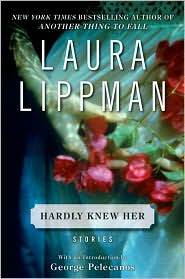
Hardly Knew Her by Laura Lippman Makes Me Want to Read More Short Stories

My love for Laura Lippman is nothing new around here. I read most of her Tess Monaghan novels long ago, in my pre-blogging days. More recently, I read each of her standalone novels. Finally, I read her latest Tess story The Girl in the Green Raincoat (first serialized in the NY Times), which was published in January 2011. Now I bring you the latest in my Lippman reading history: her short story collection, Hardly Knew Her. Then my Lippman raving will cease -- at least, until she releases a new title.

As a rule, I'm not a fan of the short story genre. Character development, intricate plot, and descriptive setting are the best three things a book has to offer, in my opinion. Short stories rarely offer any of these. They are often too short for characters to develop, an intricate plot to unfold, or the setting to be described. Imagine my surprise when I found myself loving Lippman's collection.

The why is as simple as this: Lippman manages to include all three of the characteristics I deem necessary for a story to be good. In each short story. That's right -- not in the collection. In each story. She pens characters with ridiculous skill, moving them from innocents to murderers before our very eyes. Plot is also (somehow) easily developed in mere pages. Likewise, Lippman manages to illustrate a strong sense of setting in a minimal word count. Rather than staying in her usual neighborhood of Baltimore (although, make no mistake about it -- she includes a lot of Baltimore), Lippman also branches out and visits New Orleans, Dublin, and other cities.

Be forewarned, however, that Hardly Knew Her is not for the faint of heart. Lippman includes some of her most sinister characters yet -- and they're usually female. Lippman offers glimpses of women no less complex than the characters of her standalone novels, if somewhat less nuanced than the character of Tess. After all, Lippman has spent hundreds of pages developing Tess, and only dozens on these latest characters. There are several who are memorable enough to perhaps be seen again (or we can hope, anyway).

Until a  new novel is released, you can get your fix of Laura Lippman's writing on her website, especially in the "Letters from Laura" archives. Better yet, get more up-to-date posts on her Journalscape, The Memory Project. (*Note: You do not have to log in to view public posts.)

Tuesday, February 8, 2011

Perfect (Pretty Little Liars Book #3) Is Pretty Much, Well... Perfect in Every Way

I know, I know. The Pretty Little Liars series by Sara Shepard is in some ways the literary equivalent of cotton candy -- fluffy, full of sugar and flavor, with little substance in the end. However, I can't stop reading these books! Something about them is addicting. Here's a short summary of the latest title I finished, Perfect, and then a short list of reasons why I love these books:

As the third book in the series, Perfect picks up where the second book -- Flawless -- left off. Hanna is still struggling with her recurring eating disorder (once conquered, but now picking up speed with the advent of the increasingly disturbing texts and messages from A). Aria revealed too much truth about A, so she is suffering the consequences: her mom kicks her out, her dad moves in with his college-age girlfriend Meredith, and Aria is left to find shelter with her new boyfriend's family. Emily is continuing to struggle with her identity, and losing the trust of her family members quickly. Her popularity at Rosewood Day, on the other hand, seems to be on the rise. Spencer is suddenly the golden child in her family after weeks of trouble with her sister. She is nominated for a Golden Orchid, an award for high school students likened to the Oscars. But she has a secret that would destroy all those good vibes instantly. Who will A torture next? The question definitely isn't "if" but "when."

Reasons I love this series:

  • Although their allowances are much bigger than mine was, these girls are very relatable. I feel like I understand their motivations, feelings, and desires. Deep down, they are just teenagers seeking a sense of self and a place in the world.
  • Each character is individually defined. Shepard manages to create a whole world full of intricate, vibrant characters who are each unique from the rest. Not many authors can accomplish this feat -- many do single characters with depth, but rarely a bevy of them.
  • It's fun to read about all that wealth. I don't have that kind of money, and (barring a lottery win or other miracle) never will. I like to hear about Rock & Republic jeans and Zac Posen dresses, even if I'll never own them -- however, through eBay all things are possible!
  • The suspense is killing me -- in a good way (obviously, if I'm still reading). This is key -- leaking the exact right amount of information, but still leaving much a mystery. Shepard hits the right balance between revealing something (subplot points and some of the girls' secrets) and nothing (A's identity, which in the third book readers are no closer to learning than when the series began). This is especially tricky for me, because I hate to wait! Case in point: How I Met Your Mother, which I realized after almost the whole first season was not going to let viewers know which storyline led to children. Perhaps viewers know now -- I don't, because I stopped watching! Shepard is a careful storyteller, and a darn good one.
I've already made my way (in one night) through the fourth book, Unbelievable, and I will be starting on the fifth, Wicked, sometime this week! They're just that good.

If you'd like, you can go ahead and order it (or any other book) online. Your purchase will help support this blog, since I am an affiliate of these stores (Amazon, Barnes & Noble, and Indiebound). For more info on this, you can read my Review Policy & Disclosures.

    LinkWithin

    Related Posts with Thumbnails