Showing posts with label Dorothea Benton Frank. Show all posts

Thursday, June 28, 2012

Book Review: Porch Lights by Dorothea Benton Frank

Southern literature queen Dorothea Benton Frank will be signing Porch Lights in Nashville tonight at Ann Patchett's bookstore Parnassus Books, and I really wish I were going. Last week I missed seeing Mary Kay Andrews at Parnassus, but I was comforted by the fact that I had previously met her. I've longed to meet Frank since adoring her first novel, Sullivan's Island. I'm actually going to be in Nashville tonight, but attending another event. My best girl friends and I are going to see Sarah McLachlan and the Nashville Symphony at the Schermerhorn. So I suppose I can be soothed by that.

A bit about the book: Army nurse Jackie Britt McMullen is home from multiple tours of duty when her husband, firefighter Jimmy McMullen, is killed while fighting a housefire. She and their ten-year-old son, Charlie, struggle to keep themselves above water in their home in Brooklyn, but Charlie slips further and further from Jackie.

In Porch Lights, Jackie decides that a trip to her family's home on Sullivan's Island is necessary for Charlie's well-being, even if residing in the same home with her mother for weeks on end may kill her. Annie Britt, Jackie's mother and a southern belle to the nth degree, thrills in her new mission -- providing healing for her grandson and daughter. She takes on their visit as her personal mission, redecorating bedrooms and planning menus. But she and Jackie haven't agreed on much of anything for years. How will they survive an entire summer together?

Why you want to read it: Frank is simply one of the best writers of southern lit in the game. Her novels are set in South Carolina's Low Country, a land with a rich history, beautiful sights, and good food. She incorporates all three into her novels, and Porch Lights is no exception. She also incorporates Edgar Allen Poe's time on Sullivan's Island into the pages of the novel, as Annie Britt is a self-taught expert on the subject. The characters visit Poe's Tavern for good eats, as well as Fort Moultrie, where Poe was stationed. Lines from Poe's short story "The Gold-bug" begin each chapter.

Frank is a master storyteller, and part of that skill lies in her ability to create dynamic characters who readers fall for despite their flaws. I enjoy her stories because I care deeply for the characters she creates. Jackie and Annie are main characters with many issues, difficult traits which cement their humanity. Jackie is stubborn when faced with her mother's efforts to help; Annie, for her part, is both stubborn and extraordinarily self-righteous. But the mother-daughter duo is also full of love for one another and for young Charlie. They both want what's best for their family, even while they don't agree on what that is. 

The side characters in Porch Lights are delightful, as well. Annie's neighbors add a sense of community to the  novel, as Jackie and Charlie are welcomed with open arms to their home-away-from-home. A handsome doctor provides a hint of romance, while best friend Deb shows readers another side of Annie. Buster (or Guster, as Charlie calls him), Annie's estranged husband and Jackie's father, brings comedy to the novel and is the perfect foil for Annie.

The bottom line: Told in alternating voices (Jackie's and Annie's), Porch Lights is a love letter to both complicated family relationships and South Carolina's Low Country. The novel celebrates both equally, in a tale that pulls at readers' heartstrings. I long to meet the characters and visit the beautiful island where they live. At its heart, Porch Lights is a novel that will remind us how important the people and places we love are.

About the author: Dorothea Benton Frank is the author of twelve previous novels, including a Christmas novella, The Christmas Pearl. All twelve are set on various islands and cities up and down the South Carolina coast, and all are a delight to read. She was born on Sullivan's Island, and now resides in both New Jersey and the South Carolina. You can read more about her and sample excerpts from her novels by visiting her website. You can also follow her on Twitter and on Facebook.

Wednesday, September 1, 2010

Lowcountry Summer Disappoints This Long-time Dorothea Benton Frank Fan

After three long weeks spent with Dorothea Benton Franks' newest release Lowcountry Summer: A Plantation Novel, I finally finished it last night. I've been a Frank fan since her first novel Sullivan's Island was published. She is a true southern author, with almost all of her books set along South Carolina's coastline. I have read all of her books, and enjoyed each one -- until this one. I'm not sure exactly why I didn't particularly like Lowcountry Summer. While I loved main character Caroline Wimbley in Franks' second novel Plantation, she somehow fell flat in this sequel. Broken following her divorce and her mother's death, Caroline was a sympathetic character in Plantation. In Lowcountry Summer she comes across as a snotty, unfeeling and archaic stereotype of a southern lady. Lowcountry Summer takes place ten years after the events in Plantation. That time frame has removed Caroline from the devastation she felt at losing her mother and failing in her marriage. Rather than growing older and wiser, she seems almost more immature in this novel.
Another problem I had with the novel was its lack of a cohesive plot. Ostensibly, the premise is Caroline's brother Trip's ongoing family issues. His estranged wife Frances Mae is still causing trouble for the Wimbley family, made worse by her ongoing alcoholism. After she is shipped off to an Intervention-style recovery center in California, Trip and his live-in girlfriend Rusty attempt to care for Trip's four daughters. They need help with the rebellious teenagers and spoiled youngest daughter, of course, from Aunt Caroline -- with varying results. I felt as though the action of the novel was far removed from the main character; although Caroline involves herself heavily in Trip's family life, it seemed staged and unrealistic. The plot just didn't flow for me.

Another issue I had with the novel was its annoying plot twist with a death (no spoiler! just a warning...) that seemed entirely unnecessary to me. It was as though Frank simply couldn't think of a way to make the last half of the novel interesting, so she threw in a death to mix things up. Frank does many things beautifully -- descriptive setting, southern dialogue, and (usually) interesting character portraits. But none of those could save her eleventh novel. I love the idea of returning to characters written about years ago; Franks' Return to Sullivan's Island was an excellent example of how sequels can work perfectly. I drooled over it! (Literally -- the recipes and food described sounded unbelievably good.) I'm still a die-hard Frank fan, and I'll continue reading her novels as soon as they come out. I just wouldn't recommend this as a good example of what she's capable of writing.

The world would be a boring place if we all felt the same about things, so here are some positive reviews of the novel to balance my opinion:

Monday, September 7, 2009

Back to the Lowcountry (Yum, Yum!)

I'm finally out of my slump of only liking Michael Connelly books. Don't get me wrong -- I still really like Connelly. Love his books. But I'm finally able to find some other books to enjoy. I had a week or two in which I just couldn't keep reading a book unless it was written by Connelly. I'm happy to say that is over!

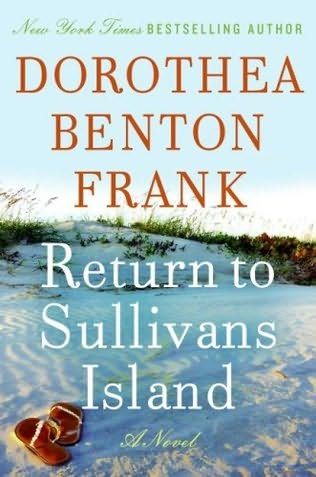
I'm about midway through Dorothea Benton Frank's latest novel, Return to Sullivans Island, and it is every bit as good as her previous novels. This one is special because it is somewhat of a sequel. Fifteen years after her debut novel Sullivan's Island, Frank returns to that South Carolina island to continue the story with the main character's daughter Beth. Through Beth the reader gets a new perspective on the family first chronicled in Sullivan's Island. In addition, Beth has a new story of her own to tell and live in the novel's pages.

Frank's characters are always a treat to get to know in her books, but what makes her an especially interesting author to read is her locale. Frank writes tales set almost exclusively in the coastal regions of South Carolina. This is a fascinating place because of its uniqueness. The islands and marshland of South Carolina have been home for hundreds of years to the Gullah people. Frank fills her novels with genuine Gullah influences, both in food and in culture.

In Return to Sullivans Island she adds an element used sparingly in her other novels -- the voodoo/ ancestry worship side of life in the lowcountry. In the novel Beth's deceased ancestors make their presence known and influence the story in subtle ways. Magic and ghosts are not something I necessarily like in a novel. However, in the setting of the island surrounded by objects and a house that has been in Beth's family for generations, it somehow fits.

Frank has a copy of a press release on her website which discusses the novel, including her own childhood growing up on Sullivans Island and her decision to do a sequel, which prior to this book she had never done. I recommend both it and the book as good reading, especially if you are female and from the south. Also on her website are some lowcountry recipes from her foodie novel Shem Creek that I haven't tried yet, but give me time and I will!

Friday, January 2, 2009

The Book Version of "Can't Hardly Wait" and More (Part 1)


Last semester, I took a course in adolescent literature which I enjoyed immensely. Most of the course consisted of reading books aimed for the middle school level through adult, which pretty much meant we could read whatever we wished. For the class, we had to keep up with our readings by compiling an annotated bibliography. There were only certain books required, but as an avid reader, I far surpassed that list. My bibliography turned out to be a lengthy list of almost all the books I read between September and December.

The following is a condensed version, which summarizes and slightly critiques each book. I'm only leaving in the ones I loved (well, and some I just liked)... Here they are in no particular order. Okay, that isn't true. They are in order alphabetically by author, but only because that's how they had to be sorted for the bibliography I turned in to my professor:

  • Deep Dish by Mary Kay Andrews: Andrews has written two very different series, the first a mystery series set in Atlanta, and the second a chick lit series that takes place in Savannah. Andrews' recent forays have been into the realm of separate, stand-alone works starring an array of new and different main characters. All are female and all are souther, but other than that the differences are many. This novel centers around the escapades of Gina Foxton, a chef with a television series on a local cable channel. When Gina has the chance to make it in show business and win her own cooking series on the national food network, she goes head to head with a know-it-all male chef who catches and hunts his own ingredients. Andrews falls short of her usually flawless plotline in this novel, giving in too easily to the current hype surrounding reality television. Some writers have managed to use the scenario successfully (such as Carolyn Parkhurst in her Amazing Race-esque novel Lost and Found), but Andrews should stick to what she knows - southern females - and stay away from what she does not - the television business. That being said, please check out both of her amazing series: the Callahan Garrity Irish Atlanta mystery books and the Savannah southern belles Weezie and BeBe in books which include Savannah Blues and Savannah Breeze.
  • The Prince of Frogtown by Rick Bragg: Bragg began the three-part saga detailing his family history with All Over But the Shoutin' in 1998, a memoir that largely centered around his mother. In the second book, Bragg stepped further back in time to research his maternal grandfather and honor him with 2002's Ava's Man. After at one time pledging that he would never write "more than three chapters" about his father, Bragg found himself plunged into a late fatherhood when he married a woman who already had a son. At this point, Bragg found himself unable to stop pondering over the brief but hard life his own father had lived. He set out to find people who had "one story, just one story" that showed that his father in a positive light. It took some time; Bragg's father was a drunkard and a violent man who beat Bragg's mother and cut more than a few men who looked at him wrong. But in this memoir, Bragg tells not so much about his father's evils as he tells about the man his father was and the man he wished he had had the chance to get to know. He learns about the main his mother fell in love with and comes to terms with his own journey into forced fatherhood. Bragg's writing, as always, is as beautiful and smooth as the stream he reminisces about in the book. He tells his father's story as he would tell it aloud, and the reader is a better person for having heard his tale. Read the first two books as pre-requisites.
  • Don't Make Me Choose Between You and My Shoes by Dixie Cash: In this hilarious installment of the Domestic Equalizers series, Cash takes the girls out of Texas and into New York City. Edwina Perkins-Martin and Debbie Sue Overstreet run both a hair salon and a private investigator business (hence, the Domestic Equalizers title for the series). Both women are known for their big hair and tendency to get into trouble during investigations. But when you put them in New York City, the chances of trouble goes up by leaps and bounds. Edwina and Debbie Sue are asked to speak at a conference for private investigators, where they end up befriending fellow Texan and loner extraordinaire Celina Phillips. Celina is a librarian in her small town, but she is a huge fan of the Domestic Equalizers and dreams of joining them in business. She raises money and uses all of her savings to send her self to NYC to the conferences, where she meets her idols and a cute policeman. The Texas girls get themselves involved in a series of murders which have been occurring in the city when they also befriend a genuine NYC hooker. All turns out well in the end, and Cash wraps everything up in a perfectly contrived romance happy ending. In spite of some downfalls, this novel is a great read for getting your mind off your own problems and delving into a book rich with funny characters and a little twist of mystery.
  • Deadline by Chris Crutcher: Crutcher describes the last year of high school senior Ben Wolf's life in this young adult novel. At the novel's beginning, Ben discovers that he has a disease which will prove fatal. Not only that, but Ben makes the decision that he will forgo treatment in exchange for living his life to the fullest. Ben plays a winning football season with his brother Cody; befriends an alcoholic, sort-of-reformed child molester; and dates the hottest girl in school. In essence, he accomplishes his dream. Crutcher describes the sports scenes in great detail, just one of the many highlights of an overall excellent book. Cruther does not make a martyr or a saint of Ben; Ben makes mistakes, as any 17-year-old would. However, he remains lovable until the very end, when of course, the reader must face Ben's imminent demise. There are many lessons to be learned in Crutcher's novel, only one of which is the mantra to "live life to the fullest."
  • Blood on the Bayou and No Mardi Gras for the Dead by D.J. Donaldson: These are actually the second and third installments in a mystery series set in the Lousiana bayou country. Main characters Andy Broussard and Kit Franklyn solve murders amid the swamp water and alligators. Broussard is an old-school medical examiner, and Franklyn joined his office as a psychologist investigating suicides for a book she has been writing for some time. Franklyn ends up investigating much more than suicides, however, as she accompanies Broussard on almost every call. In Blood, Broussard's past comes into play and he learns more than he would like to about some old friends. I immensely enjoyed this novel and its New Orleans and bayou country setting. It was a short but satisfying complex mystery with just enough intrigue and gristle. Donaldson followed Blood with No Mardi Gras starring, once again, the team of Broussard and Franklyn. This time the action starts in Franklyn's backyard - literally - and ends up, once again, in the recent past as Franklyn begins investigating the murder of a young girl whose body is found buried there. Donaldson continues the New Orleans and bayou setting in this novel, which thrills me as a French Quarter junkie. Another short and delightful mystery which still maintains an element of surprise.
  • I Love You, Beth Cooper by Larry Doyle: Like the Toms - Wolfe and Perotta - Doyle uses pop culture to drive this fascinating novel. Doyle gives us the story of high school senior Denis Cooverman on the day of his graduation. Denis is the ultimate geek, and as valedictorian, is also chosen to give his school's graduation speech. Choosing to forgo the usual "Oh, the Places You Will Go" motivational speech, Cooverman instead calls out all of his classmates for their bad behavior and hidden secrets, ending as he announces to thehead cheerleader (way out of his league): "I love you, Beth Cooper." Doyle follows Cooverman for the rest of the evening to the cliched post-graduation party complete with the aforementioned cheerleader, jocks, "goths," nerds, and drunk former-wallflowers. Doyle does so with hilarity and precision, resulting in a fabulous novel reminiscent of the blockbuster movie Can't Hardly Wait.
  • Bulls Island by Dorothea Benton Frank: I love everything Dorothea Benton Frank has written, from her first novel to this latest one. Frank is a southern belle who writes about the south with the fabulous cynicism of a New Yorker. All of Frank's novels are set (at least in part), in her native South Carolina, and in each one Frank manages to entice her readers with a new and different slice of South Carolina low country, especially the islands that are so prominent in that area. In this novel Frank returns to a style of novel she is especially adept at writing - the woman who has left the south for greater things, ends up having to return for reasons beyond her control, and realizes her true place is in the south. This time the protagonist is Betts McGee, a career-minded woman living in NYC. She returns home to complete a business deal, which happens to be with her ex-fiance's company. Throughout the course of the novel, which ends up slightly predictable, Betts slowly comes to realize what her life is missing - the south, of course! While some might fault Frank for her sometimes formula-esque writing, I simply enjoy reading anything she puts out there for me to read. Formula or not, she is a good friend of and constantly endorsed by author Pat Conroy. To me, that's reason enough to pick up one of her excellent books.
  • Are You There, Vodka? It's Me, Chelsea by Chelsea Handler: As a fan of her E! show Chelsea Lately, I picked up Handler's book prior to the Thanksgiving holidays, when I needed much entertainment. It was a surprisingly great read. Handler writes hilarious accounts of her life, from being tortured in school by bullies who called her "dog" on a regular basis, to drunken one-nigh-stands twenty years later in her Hollywood life. Handler is every bit as funny as a writer as she is doing monologues on her television show. She writes like she talks: intelligently, sarcastically, and laugh-out-loud funny. She is every bit as entertaining as David Sedaris, while perhaps a bit more of a lush (I mean, the title of her book does liken vodka to God). I would recommend this to anyone with a sharp sense of humor who is willing to let their morals go for a few hours and allow themselves to be entertained by Chelsea's crazy tales.
  • While They Slept: An Inquire into the Murder of a Family by Kathryn Harrison: In this nonfiction book, Harrison delves into the depths of the Gilley family of Oregon. In 1984, the oldest son Billy killed both his parents and his youngest sister Becky. The middle sister Jody was left out of Billy's rampage. It was she who escaped from the house with him and went to a neighbor's house, where the police were eventually called. Harrison gained trust with both Jody, who is living in NYC now, and with Billy, who is serving time in an Oregon prison. In the style of Truman Capote's In Cold Blood, Harrison tells the story of both the Gilley family's life and their deaths. It is a haunting story with no true conclusions; Billy still seems to see himself as the avenger for his sister by helping her escape their abusive parents. He does regret the murder of his youngest sister, who was eleven at the time of her death. He tells Harrison that he panicked and killed her to keep her from screaming; he never intended to kill Jody, who some have suggested may have been more than the object of sibling love for him. It is an interest-grabbing book, as most true crime volumes are. However, this one in particular is interesting because of the personal link Harrison finds between herself and these two children of abuse. Harrision herself was the victim of abuse by her own father. In her teens, her father came into her life for the first time and seduced her into a sexual relationship. Harrison tells the Gilley's story as a manner of exploring her own, which she actually wrote about in more depth in the previous book The Kiss.

LinkWithin

Related Posts with Thumbnails