Monday, May 31, 2010

'Dead in the Family' Gives Readers More Sookie, But Little Plot

To say I was excited to read Charlaine Harris's newest Sookie Stackhouse novel would be like saying the Sears Tower is kind of tall. It is, and I was. (Notice the past tense -- "was." Not "am.") Dead in the Family is the tenth installment in the Sookie Stackhouse series (not including the Sookie universe set of short stories published recently), better known as the True Blood books. I first came to the series as a TB fan who wanted more. I couldn't believe I'd never heard of a mystery series set in Louisiana, as both southern lit and mysteries are favorite genres of mine. More than likely, its supernatural characters kept it under my radar. "Supernatural" or "vampires" is never a word I've used when searching for new book titles.

After watching season one of the hit HBO television show, however, I wanted to know everything there was to know about Sookie Stackhouse and her friends (and enemies) in small-town Bon Temps, Louisiana. And so I breezed through the first eight books with record speed (think weeks, not months). Thankfully, Harris's next novel Dead and Gone was released just as I finished the first eight books, and so I was able to read it in order and quickly. Then I had to wait for the short story collection. I was wholly unimpressed with it; there wasn't really anything wrong with it, it just wasn't... Well. Enough.

Flash forward to May 2010 and the release of the next real Sookie novel, Dead in the Family. I couldn't wait to get my hands on it; it waited in my Amazon.com cart for months, just so I would remember the date it was published. I bought it a couple of weeks ago, and read it last week. And... I was horribly disappointed. I read it primarily because I have this need to know where a series (especially one I have read every other book in) is going next. I still really like Sookie; her character and her quirks are one of the only saving graces of this novel. The plot leaves much to be desired. Nothing really happens. Sure, Eric Northman factors in, but after several books detailing their relationship, I have to be honest and say I'm over it. Sookie needs some new meat, and I don't mean that figuratively -- it becomes quite literal when the body of her love interest is thousands of years old.

Harris treats the entire book as a follow-up for several old plots: Sookie continues to recuperate from the injuries garnered by fairies in Dead and Gone. Fallout from the Fae War continues to also play a part in the action (or non-action, in this case). There is minimal discussion about her brother Jason's life after the death of his wife. And Eric's maker comes, re-hashing a tired plot involving the ins and outs of the vampire maker/child relationship (which Harris much better illustrated in Book#3 Club Dead's plot involving Vampire Bill and his maker Lorena). Harris also brings back the wolfpack and Alcide, but not enough for it to make things interesting.

All in all, there was way too much dwelling on the past, way too little forward-action in the plot, and no new interesting characters to speak of. Bottom line? Read it if you're a die-hard fan who can't get enough of Sookie and friends. Skip it if you've never read a Southern Vampire Mystery series novel before. But no matter whether you read it or not, be sure to tune in June 13 for the HBO season three premiere of True Blood. It should be loosely based on Book#3 Club Dead (if the past two seasons are any indication of a pattern, they've produced one season per book), which was one of the best novels in the series.

A True Blood Season 3 trailer to convince you:

Tuesday, May 25, 2010

'The Tale of Halcyon Crane' Proves to be Hauntingly Entertaining

Hallie James lost both her father and her mother in just a few short days. Her father, she had counted on losing since his downward spiral into dementia forced her to seek help from a local assisted living home. Her mother, she thought she had lost long ago. In a letter from a far away law firm, Hallie learns of her mother's very recent death. Having been told her entire life that her mother perished in a house fire when she was five years old, Hallie is understandably shaken. With little left in her coastal Washington state town, Hallie makes a trek to Lake Superior and the remote island of Grand Manitou. She finds out upon her arrival that there are more than simple family secrets to discover. When strange and frightening things begin to happen in her family's homestead, Hallie begins to wonder if ghosts exist after all.

The Tale of Halcyon Crane
author Wendy Webb has been a journalist for more than twenty years, and journalism's straight-forward style of writing is evident in the novel. While a spine-chilling tale of ghosts and ancestors and secrets long buried emerges, Webb does so on a lower reading level than most literary mysteries. The book, even with its adult characters and situations, reads almost like a young adult novel. Even as I say that, I must admit that I highly enjoyed the late, scary nights that I was reading Halcyon Crane. Word choice leaned more towards young adult, as did some of Webb's plot development. Hallie falls immediately in love with her mother's lawyer and her own childhood friend, within days of meeting him. I found the supposed love story a bit thin and immature as a result of its haste. Also, the plot varies between present-day action and tales of Hallie's family relayed to her by a woman who claims to be the household maid. Many indicators tell readers that there is more to this woman than meets the eye, a fact which ends up to be true in the end and of which Hallie seems perpetually ignorant.

Despite some of the less developed or literary traits of Webb's writing and of the novel in general, The Tale of Halcyon Crane remains a fun and entertaining read. Some of the flashback and ghost scenes are spectacularly spooky. I tossed and turned whenever I could finally get to sleep for the duration of my reading the book. And perhaps most effective is Webb's development of the island itself as a character in the novel. Based on Lake Michigan's Mackinac Island rather than the similarly-named North and South Manitou islands, Webb's fictional Grand Manitou is a picturesque version of an old-school resort community in the Great Lakes. Like Mackinac, Grand Manitou has no motorized vehicles, residents instead traveling by horse and carriage, bicycle, or foot. The minimal modern conveniences lend both a quaint homeyness and a forboding sense of gloom to the Victorian-style island.

Overall, Halcyon Crane was neither the best nor the worst book I've read this year. I will look forward to Webb's next novel and to following her development as a new fiction writer from her long-time career as a journalist. Many book bloggers and reviewers had only glowing things to say about this gothic novel. Read an excerpt to decide whether or not you'll visit the creepy island yourself.

Monday, May 24, 2010

My Big Fat What-I-Read-On-My-Road-Trip Post

Last Thursday morning, my boyfriend & I left bright and early to go on a weekend road trip. We had been invited by his brother & sister-in-law to stay at a cabin an hour or two south of Atlanta, Georgia, so that was our first destination. We made a couple of stops along the way -- notably, I spent some time in the new McKay Used Books store in Chattanooga. I visited their old building probably once a week during my college years at UT Chattanooga, but I hadn't been to their new store location until this weekend. Very nice, and almost an exact replica of their Knoxville location.

I picked up several new books, including a paperback copy of Joshilyn Jackson's first novel gods in Alabama. I read it years ago, but wanted to re-read it before the release date of Jackson's newest novel Backseat Saints (you can read my original review here, but look for an upcoming double book review/ comparison coming on Saint's release date in June). I had one at home, but couldn't resist picking it up to take with me to read on vacation. I also bought Saving CeeCee Honeycutt by Beth Hoffman, which has been reviewed on many book blogs and which my favorite high school librarian recently told me I had to read. Also bought at McKay's: Cleaving by Julie & Julia author Julie Powell, Target Underwear and a Vera Wang Gown: Notes From a Single Girl's Closet by Adena Halpern, and The Friday Night Knitting Club by Kate Jacobs (who also wrote Comfort Food, which I loved).

Then lunch at Panera Bread in Atlanta. So good, and seriously? Why can't we get one of these in my town? We're not so big, but we are a university town & on the interstate to boot. We also made a stop (my first time ever) at Trader Joe's in Atlanta, which was everything I thought it would be (and more!). We're definitely going to be making a run to the Nashville location once a month or so for some staples.

My plan for the weekend was to lay in the sun, relax, and read, read, read. In the car, I listened to Patricia Cornwell's At Risk. I am a huge Cornwell fan, having read every Kay Scarpetta novel and every Andy Brazil novel. It would make sense for me to really like the Win Garano series, too, right? Well, I didn't. I listened to the entire thing, so I made it through, but I didn't enjoy it as much as Cornwell's other books. Originally published in serial form in the NY Times Magazine, the novella focuses on Massachusetts State Police investigator Win Garano. His boss, a female district attorney for Boston, orders him to look into a cold case in Tennessee with the hope that solving it will help her political career. When an act of violence stops them both in their tracks, Win begins questioning her motives. I found the characters much less sympathetic than Cornwell's other protagonists. Due to its short length, it was also difficult to really get into the plot, as things happen quickly and without much development. At Risk was recently made into a Lifetime Television movie, which I may watch simply to see the novella come to life.

When we arrived at the (absolutely beautiful) cabin on a private lake, I read Joshilyn Jackson's gods in Alabama in less than 24 hours. It was phenomenal the second time around, and you'll be able to read my thoughts on it in my post June 8th about it and Backseat Saints.

The next novel in my Kathy Reichs's Tempe Brennan series quest was Bones to Ashes, and so I delved into its pages as I laid on the beach on Hilton Head Island and then as Brent fished off the pier on Tybee Island. We decided that since we were so close to the coast (about 4 hours from the cabin), we would regret it if we didn't spend at least one night at the beach. So we visited the beach on HHI at Folly Field, stayed the night on Hilton Head (and visited the oh-so-fun Salty Dog & had our pictures made on their webcam) and then the beach on Tybee Island the next day. In this tenth novel in the series, Tempe is back in Montreal for the summer. When a police officer is found with a skeleton as a morbid collector's item, Tempe begins examining it and pondering the disappearance forty years ago of her childhood friend Evangeline. Reichs also continues the on-again-off-again romance between Tempe and Canadian police investigator Andrew Ryan. Reichs sneaks in another appearance by Tempe's crazy sister Harry, which makes the novel all the more enjoyable. Definitely a good inclusion for the series, and Reichs also involves leprosy in the plot. Very interesting, and with historically accurate information.

Since arriving home last night, I've begun Charlaine Harris's newest Sookie Stackhouse novel, Dead in the Family, which came in an order from Amazon while we were gone over the weekend. It's definitely getting me in the mood for True Blood season 3 in June! I'm currently listening to Tess Gerritsen's Body Double on my iPod, so posts about those two will be coming soon.

Tuesday, May 18, 2010

I Read 'Shadow Tag' in Less Than 24 Hrs -- That's How Good It Is.


Louise Erdrich has never appealed to me as a writer. Perhaps it is because I knew her only as a Native American writer, and felt her stories had little to do with my life. I also think I may have read a short story by Erdrich in my college English classes and didn't enjoy it then. For whatever reason, I largely ignored her subsequent career and book releases. Also for whatever reason, I picked up a copy of her newest novel Shadow Tag off the "new book" shelves at my local library last week.

Shadow Tag tells the simple story of a family's daily life. Gil, the father, is a world-renowned artist whose paintings of his wife Irene have sold for large amounts of money and financially supported the family for many years. Irene is an academic who never quite finished her doctorate, instead focusing her energy on raising her children and posing for her portraits with Gil. Their children, Florian, Riel, and Stoney, range in ages from 13 to 6 years old and struggle with their own age-appropriate issues -- book reports and stuffed animals.

However, throughout the course of the novel, Erdrich describes those events which make the family not ordinary, but rather quite extraordinary. There are, first of all, the diaries. Irene is a journal-keeper, having written in diaries her entire life. One day, Gil breaks her trust and reads the diary Irene considers a private extension of her soul. With that betrayal, the family is sent into a tailspin of destruction. Gil is obsessed with his wife's private life, Irene with finding her privacy again, and the children with this tension that now exists between their parents. The children, Riel in particular, make the novel heartbreaking in its brutal honesty about the truths that they sense, even when nothing is spoken aloud.

Erdrich's writing is beautiful and haunting. She references the family's Native American roots, but never slaps readers in the face with an educational agenda. Rather, it is a novel about a family whose members happen to have Native ancestry. This ancestry plays a part in their lives, as all of our histories affect our futures. The narrative flows easily, even through changes in narrators and point of view from first to third. In the end, Shadow Tag evolves into the story of a family who loves one another, but also has its tragic flaws.

Interesting is the novel's connections to Erdrich's own personal life. She was married to fellow Native American writer Michael Dorris, but their marriage ended in divorce after they had three children together. Coupled with that tragedy, they were accused by at least one of their children of child abuse in later years. Erdrich's ex-husband committed suicide in 1997. While the novel differs in detail from Erdrich's own life, readers may find parallels from the obvious tragedy that exists in Erdrich's story and the story of Gil and Irene.

For more info on Erdrich's other books, see her HarperCollins Publishers website. In addition to being a bestselling author, Erdrich also owns an independent bookstore in Minnesota called Birchbark Books.

Monday, May 17, 2010

Learn About Romance, Eating, and Living French-Style in 'Lunch in Paris'


My favorite type of non-fiction is the foodie/travel/memoir. Kim Sunee did an excellent job with her 2008 book Trail of Crumbs, which details her story of adoption from South Korea to New Orleans, then eventual move to France, and now I've found my next Sunee -- Elizabeth Bard and her memoir Lunch in Paris: A Love Story, with Recipes. Bard is a journalist from the United States who found herself living in London, and then -- by accident of love -- in Paris.

As Bard recalls her romance with Gwendal, a Frenchman through and through, she examines her true ambitions and how they fit with her new life in a slow-paced city. And, of course, she details each meal. Bard includes a wide scope of all things French, from the open air markets where she buys vegetables each day to the butcher shop with its crazy schedule (closed Monday, open Tuesday through Saturday but closed from 1pm - 3:30pm for lunch, closed Thursday afternoons, open Sunday mornings). Most importantly, she discusses the importance of eating in France and its link to social customs. She talks in detail about the food served at her wedding, the sixteen-course North African meal served on New Year's Eve by her brother-in-law, and a Passover feast she herself prepares.

Included throughout the memoir sections are recipes, which Bard explains are just starting points -- with each, she offers other ingredients which could be used, variations on preparation, and multiple serving suggestions. Some are not things I would probably ever make (I'm not even sure where I would find whole Octopus in the middle of Tennessee in order to make a salad...), but others are excellent -- a chocolate souffle cake and a method for cooking fish wrapped in packets in the oven come to mind immediately as recipes I will try in the near future.

Bard writes a foodie blog called Lunch in Paris, where she continues to share daily recipes.

Sunday, May 16, 2010

'Fireworks Over Toccoa' is Less Than Spectacular


Southern literature is my favorite genre, but even it can fail to entertain. Thus was the case in the highly lauded, but ultimately disappointing new novel Fireworks Over Toccoa by Jeffrey Stepakoff.

The caveat: Fans of Nicholas Sparks will love the novel. I don't happen to be a fan of Sparks. I am among the thousands who loved the movie version of The Notebook, but any attempts to read his books have resulted in much eye-rolling by me. Why? I'm not sure exactly. Overly dramatic. Full of cliche. Heavily focused on the emotion (love, grief, guilt, etc.) but without the character development I would like to see in a really good novel. More than that, the writing style is just not something I'm interested in. I guess the bottom line is just that it's not my cup of tea; however, it is for many, many people. And I believe Sparks's numerous fans will enjoy Fireworks Over Toccoa.

The novel is framed by a present-day tale which reverts through storytelling into a tale of long ago. (Sound familiar?) When engaged city girl Colleen goes home to visit her grandmother Lily in rural Georgia, she learns the story of her grandmother's first marriage. Lily was married during World War II, just days before her husband left to go overseas. During his three year absence, Lily becomes a different person than the girl she was at 17. As time nears for her husband's return, Lily is faced with decisions about her future and her family. Her father, a Coca Cola executive, and her mother are an integral part of this decision-making process, as they have shaped each step thus far of Lily's life. Thrown into the mix is Italian-American (and just-returned WWII veteran) Jake Russo, who has come to town to produce Toccoa's fireworks display for the 4th of July.

Some of Stepakoff's descriptions of the town of Toccoa and its surroundings are beautiful. But the characters fell flat, the plot was a worn conglomeration of love stories already written, and the setting (the small-town south) never popped as I would have liked to have seen it. For southern literature to be great, the setting has to almost become another character in a novel. Stepakoff's fictional debut fell below my expectations.

Friday, May 14, 2010

'Monkeewrench' Is a Character-Driven Wild Ride


An online serial killer game incites a cluster of murders in the Minneapolis area. In rural Wisconsin, two people are brutally killed inside a Catholic church. Is there a connection? In mother-daughter team P.J. Tracy's first novel, Monkeewrench, big-city police, rural sheriff's deputies, and FBI agents find themselves entangled in a mess of such great proportions that none of them are prepared for the answers.

It begins with the software company Monkeewrench. Long known for their educational children's computer games, the members greedily decide to venture out into a true money-making field -- online games full of violence and adult themes. What results is a serial killer game, similar to the CSI games that have proven so popular. In the game, players examine murder scenes and use information gathered to narrow the suspect list. After the game is leaked to a select few hundred users for test rounds, murders begin to occur. In order. Exactly as they occur in the game. Widespread panic ensues, with victims turning up every 24 hours and a suspect list as long as the game's hundreds of players. But why this game? As the police investigate, they learn that there is more to the Monkeewrench members than meets the eye.

The mother-daughter team that writes as pen name P.J. Tracy is talented in both their characterization and in their ability to write exciting, action-filled plot twists. The myriad of characters fairly jump off the page. Among my favorites were the gruff police detective duo of Gino and Magozzi, the quietly troubled game-creator Grace, and the voluptuous (both in personality and in body) software maven/ clotheshorse Annie. However, at the beginning of the novel, the number of characters and the close attention paid to them was slightly confusing. I kept having to flip back when I started a new chapter, wondering if I had forgotten a character and situation or if this was yet another new one I needed to remember.

Also, while the plot is exciting and quick-paced, I felt almost a little too clued-in to the mystery. This is one of the only mystery novels I remember reading in which I knew "whodunit" before those investigating did. In some novels that happens just before the characters learn it (the killer is walking into a building where the detective is alone, and you realize in the split second before the protagonist sees them who it is and what that means), and that's okay with me. But I felt there were almost too many clues in this novel. The killer who is eventually outed was a suspicious person to me throughout the entire novel, for reasons revealed in the storyline. I didn't like the feeling that I should be shouting to characters in the novel, "Don't go in there!" as though it were a sloppily-made horror flick. You know the type -- characters walking up the stairs, and all the while you -- the viewer -- know good and well the killer is hiding in an upstairs closet.

Overall, however, Monkeewrench was smartly written and full of likable characters who will keep readers coming back for more about what happens to them in the future. There are four other titles in the Monkeewrench series, so should you be interested in what happens next, you should be able to find out! Not sure if you're in favor or not? Read an excerpt before buying or checking it out from the library.

Wednesday, May 12, 2010

Currently Reading...

In the past week, I haven't completed a single book, but I've had an incredible time reading all the ones I'm midway through. Sometimes switching it up is not a bad thing -- it's exactly what I want to do. It's difficult to concentrate on an individual piece of writing when I am always reading about the next hot release on my favorite book blogs, using the browsing feature on Amazon.com which just links and links and links, passing through bookstores (where I have no business in the first place), happening upon books that are part of a series (which means the other series books have to be added to my to-be-read list), searching for new titles on my local library shelves.... You get the picture.

So the books that I'm currently reading (and loving!) and how I found them:


  • Monkeewrench by P. J. Tracy -- Last week Kay at My Random Acts of Reading reviewed the fifth and most recent release in the Monkeewrench series. How this series had existed below my radar, I'll never know, but I luckily found the first two books while browsing the hodgepodge of items available at the Book Cellar in Crossville, Tennessee. Score! I'm on page 240 and speeding through to the end soon.
  • Lunch in Paris: A Love Story with Recipes by Elizabeth Bard -- I love to browse the new books section at the library, and when I found this memoir involving travel and eating, I knew I had to read it. Plus, the cover has a quote/review from Adriana Trigiani, so it couldn't be bad! Currently on page 189 and reading sporadically when I need a break from murder mysteries.
  • Major Pettigrew's Last Stand by Helen Simonson -- I found this oft-reviewed new book at the library... Patrons in my small town were obviously unaware of the hype the book has been receiving, so good for me! I've only just begun it (in the first few pages), so we'll see how it goes.
  • Fireworks Over Toccoa by Jeffrey Stepakoff -- This novel was also included on many book bloggers' sites over the past couple of months. I'm more than halfway through it, and if I read it straight through it wouldn't take long at all. It's a little too Nicholas Sparks for my taste, but I'm sure that means it will really take off at some point. The storyline thus far would make for a great The Notebook-esque summer blockbuster. Again, found it on the "New Book Shelves" at my local library, so the buzz hasn't hit the small towns yet.
  • Daddy's Girl by Lisa Scottoline -- I'm listening to this book on audio, and I've only made it through CD 1 of 8. Not sure this one will be finished. I just can't get into it yet. I had never heard of it, so it wasn't recommended from anywhere -- just searching library shelves for something exciting to listen to next. So far, this isn't it.
The race is on... Let's see which book I finish first! (My own bet is on Monkeewrench, since I can't seem to get it out of my hand.)

Sunday, May 9, 2010

Mother's Day: An e. e. cummings Tribute

My gorgeous mother with new grandbaby, my nephew Jude

My mother is a woman "more precious than rubies" in so many ways. In addition to possessing a loving, giving spirit which is a constant inspiration to me, she has also surrounded me by a group of strong women who act as "second mothers" to me. Some of these have been family members: her sister -- my wonderful Aunt Carole (and my namesake); my two grandmothers and my great-grandmother (my paternal grandmother's mother) who lived to nearly 100; my paternal grandmother's half a dozen sisters -- "great"-aunts in more than one way; her first cousins Melba and Marsha, who were more like sisters to her and aunts to me.
Others have been my mother's good friends -- mothers of my playmates, fellow teachers, church members from various congregations, and now her prayer group members, to whom that label is really a misnomer.

"Prayer group members" conjures a picture of pious women who meet once a week or once a month to discuss Biblical issues only. My mother's friends, and my "second mothers", are involved in every aspect of each others' lives. They pray together, surely; but they also eat, laugh, swim, vacation, shop, and work (in some instances) together. And they are there for one another not only in good times (vacation, shopping, eating), but in hard times as well. Divorce, cancer, and even death have affected their tightly-knit group, and through it all they remain exactly where they want to be -- by each others' sides. They have all acted in one way or another "motherly" towards me, but most of all, my mother's including me in some of their activities has allowed me to experience the richness of character that is their example. How to be loving, caring women -- and isn't that the true definition of a mother? "One who cares for..."?

The following is a poem that makes me think of my mother and all the wisdom she has imparted upon me. I am not a huge lover of poetry, but e. e. cummings is one of my favorites. Here is cummings's poem to his own mother, and so I may steal the sentiment:
if there are any heavens my mother will(all by herself)have
one. It will not be a pansy heaven nor
a fragile heaven of lilies-of-the-valley but
it will be a heaven of blackred roses

my father will be(deep like a rose
tall like a rose)

standing near my
(swaying over her
silent)
with eyes which are really petals and see

nothing with the face of a poet really which
is a flower and not a face with
hands
which whisper
This is my beloved my
(suddenly in sunlight

he will bow,

& the whole garden will bow)

So with those words from e. e. cummings, happy Mother's Day to my own mother and to all the other mothers out there who struggle each day to do the best they can by their children, whether those be biological children or just children who they "adopt" and take under their wings. (Notably, my sister-in-law, who is a new mommy this year!)


My beautiful nephew Jude with his mommy Holly

Saturday, May 8, 2010

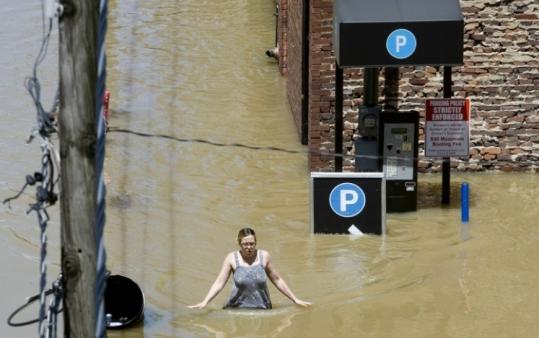
Nashville Flood 2010 & How to Help

Photo courtesy of The Boston Globe

Last weekend my state was devastated by flood waters that breached 500-year flood levels. Here, about an hour from Nashville, we have been uber-aware of all that has gone on. We know people who lost their homes and businesses, are aware of people who lost lives, have walked in the streets that disappeared below raging waters, eaten in restaurants destroyed by the storm, shopped at the damaged Opry Mills, stayed at the water-filled Opryland Hotel (or just stopped by to see the magnificent Christmas lights display each year), and cheered the Titans in the flooded LP Field stadium.

A lot of attention has been given to the lack of coverage by the national media in light of the oil spill in the Gulf, which has devastated that area, as well. Despite this, President Obama has declared more than 20 counties in Tennessee areas of national disaster, with funding (hopefully) to come soon.

My ray of sunshine amid all this devastation has been the people who live here. Country music stars came out in full force Thursday evening during Channel 4's Flood Relief with Vince Gill & Friends telethon. Over $1.7 million was raised as viewers watched those celebrities answer phones, speak about their own property losses, and -- of course -- entertain with mini-concerts. Taylor Swift donated $500,000; Bud Adams and the NFL, $400,000; Toyota gave $25,000; Lowe's donated $50,000; and of course thousands of individuals donated $10, $20, $50, and $100 as they were able. Over 7,000 volunteers have signed up with Hands On Nashville to help with relief and clean-up efforts; this is, of course, in addition to the thousands who helped during the flood and who have already been aiding their neighbors in beginning to pick up the pieces left behind in the flood.

Other things that are going on currently and in the next few weeks to help:


One of many YouTube videos documenting the floods:

Thursday, May 6, 2010

'The Neighbor' on Audiobook Made Even Laundry Fun... Well, Almost


I have developed a whole new appreciation for audiobooks in the last week. I checked out both Patricia Cornwell's At Risk and Lisa Gardner's The Neighbor. I was prompted to do so by a post I read about joining tracks together to make it easier to transfer audiobook CDs to my iPod. To be honest, I had never thought of doing such a thing -- I assumed the audiobooks at the library were somehow protected from being copied. According to reputable sources, however, burning an audiobook to your iTunes & iPod for the purposes of listening to it, then deleting it, is legal under fair use laws. So, I tried it, and it worked.

For Christmas, I got a new car stereo which plays from an iPod cord, an SD card, and a USB device, but not CDs. Library audiobooks obviously seemed to be something I couldn't take advantage of. That is, until I learned about transferring an audiobook to iTunes and to my iPod. Now, I can't imagine NOT having an audiobook on my iPod. I listened in the car, while going to sleep, and while cleaning my house. Laundry to fold? No problem! I've got a book to listen to! Long drive for work? Can't wait! I've got a book to listen to! In short, this has opened up a whole new world for me, and I'll never be the same.

That being said, I still stand by my earlier statement that an audiobook is made or lost in its reader. A boring voice cannot bring even the best book to life, but interesting, well-done voices can do wonders for a so-so book.

Cornwell (who I LOVE)'s At Risk was discarded halfway through the third disc, but Lisa Gardner's The Neighbor proved to be possibly the best audiobook I've ever listened to. Four different actors read from the novel, which worked well with the novel's different narrators and sections. Most of the novel is in third-person, with various characters being focused on in different sections, but there are also flashback sections told in first-person through the voice of Sandra Jones, one of the main characters. It was an extraordinary decision, to have different people read these parts, and it made the audiobook a rich interpretation of the book.

In the novel, 23-year-old Sandra Jones disappears, leaving behind her four-year-old daughter and husband. As detectives race to find the young mother before the critical first 48 hours is up, they uncover not one but several persons of interest in the case. As one detective observes, it seems as though they are in an episode of Law & Order, with too many suspects and not enough evidence. Everywhere they turn, there are secrets and cover-ups. Was it Sandra's own husband Jason, who has little by way of a paper trail before his marriage? Or Sandra's father, the southern judge from Georgia whose deceased wife Sandra has accused of abuse? Or perhaps the registered sex offender who lives just houses away from the Jones family? Gardner does an excellent job of releasing just enough information that you are interested, without giving anything away until the very end. Suffice it to say I was on the edge of my seat throughout the entire novel (which, due to the length of the audiobook, was days!).

At eleven discs of over an hour each, the audiobook took almost a week for me to complete. But every second was worth it, as I can't imagine a richer experience had I read the book myself in a shorter time period. The Neighbor will have you jumping at bumps in the night and wondering at its close just who the bad guys were exactly.

(*As a note, after looking at Gardner's website in preparation for this post, I realized that this novel is part of a series... That's right. A series. Which I began at the end. Again. With the same author! Last fall, I listened to one of Gardner's books on CD, which turned out to be part of a series. This novel is the third in a series about Detective D.D. Warren. I'm pretty irritated about starting halfway in; on the upside, at least there are more books to add to my to-read list that I'm almost guaranteed to enjoy!)

Tuesday, May 4, 2010

Re-visiting Hurrican Ivan in 'Point Clear'

Hurricane Ivan struck the Gulf Coast in September 2004, causing billions of dollars in damage from Mobile, Alabama, to Panama City Beach, Florida. My dad's engineering company contracted with FEMA in the clean-up relief efforts, and he was sent to that region to help for several months. We had Thanksgiving in Destin, Florida, that year, and visited several other times. During our trips, we would travel to the areas affected most -- Pensacola being a prominent area hit. The devastation was total, with homes and beaches affected with little relief in sight. Although Hurricane Katrina would strike the very next year, at the time it seemed no hurricane could do more damage.

Jennifer Paddock's novel Point Clear is about Hurricane Ivan and the experience of main character Caroline Berry during the storm. Caroline is a twenty-something writer from Oklahoma who now lives in New York City. Lately her writing career seems a bit murky, and she takes three weeks off to vacation at the beach in Point Clear, Alabama, at the Grand Hotel. Her parents once vacationed there, and she believes that in some way this trip will make her feel closer to her deceased father. However, when she arrives she learns that Hurricane Ivan is making its way towards the Gulf Coast. Rather than evacuate, Caroline decides to wait the storm out in the hotel. The morning after the storm, Caroline meets a world-class swimmer named Walker, who dives into the murky Gulf waters just after their conversation. When Walker doesn't resurface days later, a search begins for him and Caroline is seemingly the last person to have seen him. His disappearance jolts Caroline into a writing frenzy as she imagines his mindset and struggles to tell his tale to perfection.

Although the novel has few plot twists, Caroline's journey is an interesting one. Her connection to Walker and her feeling that in some ways they are the same person makes for interesting reading. Paddock includes a novel-within-a-novel with several rewrites as Caroline re-imagines Walker's time in the water.

Sunday, May 2, 2010

Continuing the Kathy Reichs Quest

Long work hours and lots of family gatherings have stopped me from talking about books individually for the past week, but my reading has primarily consisted of Kathy Reichs and her heroine Tempe Brennan.

Last weekend I read the excellent but almost-too-disturbing-to-finish Monday Mourning. Tempe is back in Montreal for this installment of the Bones-inspiring series. When three sets of bones are found buried in a pizza parlor basement, police are convinced they date to the nineteenth century when the building was built. Tempe has other thoughts on the matter, and she digs until a pattern of missing girls over a series of years emerges. The dark truth revealed in the last few pages caused me to scan rather than read. I wanted to learn what happened, but the details were too much for me (especially right before turning out the light to go to sleep!). Reichs touches on a dark topic in the end which crossed a line I wasn't prepared to cross in my reading for entertainment.

Next in chronological order was Reichs' Cross Bones. This is a Da Vinci Code-esque novel that addresses the sale of religious antiquities in relation to the death of an Orthodox Jewish man who made his living selling such items. Another theme in the novel is the discovery of several different locations anthropologists and religious experts claim as Jesus's tomb. Although the novel didn't appeal to me with its topic, I love Tempe and so I tried it anyway. I abandoned it a third of the way into the book. The focus on religion and ancient burial sites (and whether something like that could even be proven), as well as Tempe's traveling to Israel wasn't something I was interested in. I'm sure many readers loved The Da Vinci Code and would enjoy this novel; I'm not one of them. So as much as I hate to admit it, my Reichs quest was somewhat interrupted by my decision to not finish the book.

In order to jump right back on the horse and into the saddle, I started Break No Bones. The novel is set in South Carolina's low country and in the city of Charleston. A southern novel, so I was destined to like it from the beginning. While conducting a student dig on an outlying island, Tempe discovers a newly buried body among the ancient bones of the Indian burial site. Tempe's friend Emma is the coroner in Charleston, so Tempe is asked to help with the investigation despite being out of her jurisdiction. When bodies continue to pile up, Tempe gets help from both her estranged husband Pete and her love interest Andrew Ryan. The three of them find themselves staying at Tempe's friend Anne's beach house, which makes for interesting scenes in Tempe's personal life.

I've recently been on an audiobook kick after reading a blogpost about how to join tracks on discs together and transfer those to my iPod to make listening in the car, while running, or even while doing chores around the house more enjoyable. More on the titles I've been listening to later!

LinkWithin

Related Posts with Thumbnails